Connecting Nature Across the Quad Cities
- National Wildlife Federation, Prairie Rivers Network, and University of Illinois Discovery Partners Institute
- Mar 20, 2026

Previously, the Quad Cities Flood Protection Corridor was known as the Quad Cities Ecological Corridor Network.
The Quad Cities region of Iowa and Illinois is rich in natural assets, from the Mississippi River and its tributaries to floodplain wetlands, prairies, and upland forests.
However, the intensity and frequency of flooding, drought, and extreme heat are expected to increase in the Quad Cities over the coming decades. Natural places like wetlands, prairies, and wooded corridors can absorb stormwater, buffer floods, filter runoff, cool neighborhoods, and create critical habitat for pollinators, birds, and other threatened species.
This study identifies a system of connected natural spaces across the region. Protecting these properties in partnership with the landowners could help protect water quality, wildlife, and way of life.
Much of the Flood Protection Corridor spans privately owned lands, including working agricultural lands, forests, and other natural or semi-natural landscapes. The inclusion of these lands in the Network does not imply any requirement for conservation or changes in land ownership or management. Rather, these areas are identified because they contribute to regional ecological connectivity, flood resilience, and environmental quality.
The Corridor is intended as a planning and visualization tool to help guide voluntary conservation, restoration, and stewardship efforts and to support collaboration among landowners, communities, and conservation partners interested in enhancing the region’s natural infrastructure.
WHAT'S AT STAKE?
- 5.5 million acres of land. The Quad Cities Flood Protection Corridor encompasses roughly 5.5 million acres, of which, only a little more than 20% (1.3 million acres) are protected.
- 4.3 million acres are unprotected. Many of these region's natural assets are isolated, unprotected, or disappearing. By identifying where natural spaces can be reconnected across jurisdictional and land ownership boundaries, this corridor analysis offers a path forward.
KEY FINDINGS
- Extensive Network Footprint and Conservation Opportunity: The mapped Corridor encompasses over 5.5 million acres of land across the bi-state Quad Cities region. Of those, a little over 20% are currently protected as parks, conservation areas, or nature preserves. However, the remaining roughly 80% are unprotected. This substantial gap highlights a tremendous conservation opportunity and urgent need to secure additional lands within the Corridor to achieve its full potential; cultivating a connected network across political boundaries can help mitigate climate-driven hazards like floods and extreme heat by working across the landscape and more broadly accrue benefits.
- Opportunity for Flood Resilient Communities: Conserving these natural spaces is key to our overall well-being—offering recreation opportunities, strengthening resilience against intensifying storms, and protecting water quality. For example, Nahant Marsh can filter up to 2 billion gallons of water during rain events, safeguarding people and infrastructure.
- Thriving Wildlife and Biodiversity: The Quad Cities' is home to several of Illinois' critical species, like Blanding’s turtle, bald eagles, the northern long-eared bat, yellow- and black-crowned night herons, and these natural spaces are critical for their survival.
- Economic Activity and Outdoor Access: Outdoor recreation such as boating, fishing, hunting, sightseeing, wildlife observation, and trail use in Illinois create a $3.2 billion annual economic impact and support 33,000 jobs statewide directly benefiting local businesses and communities within the Quad Cities as well.
ADDITIONAL RESOURCES
- Ecological Corridor Webinar Recording (previously, the Flood Protection Corridor was known as the Ecological Corridor)
- Navigating Climate Challenges in the Quad Cities: A Comprehensive Assessment and Paths to Resilience

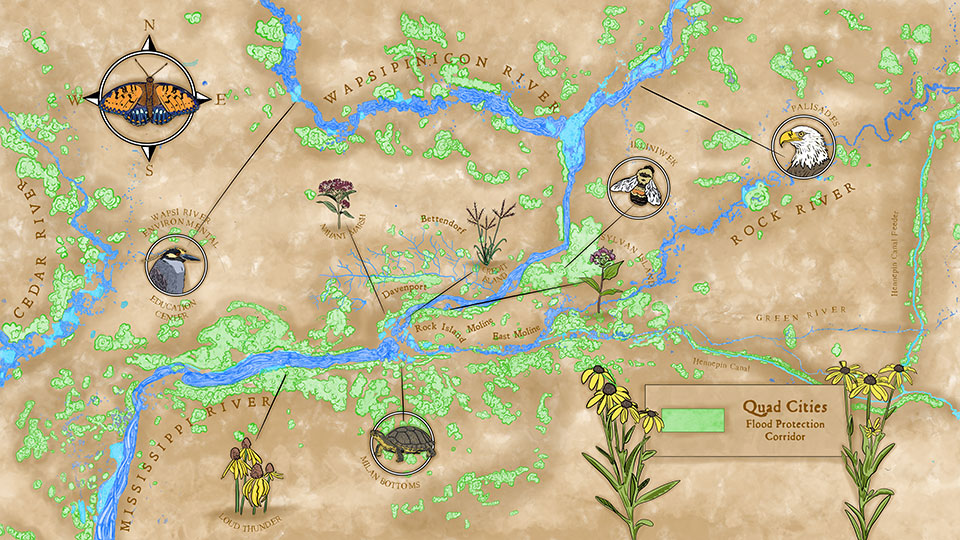
Map illustration by local Quad Cities artist Meghan Hollister.
Quad Cities Flood Protection Corridor: Connecting Nature Across the Quad Cities