Meet the Pack: Fall 2025 Contributors
Get to know some of the talented writers and photographers behind the Fall 2025 issue of National Wildlife magazine
- By Laura Tangley, Delaney McPherson and Jennifer Wehunt
- NWF News
- Sep 24, 2025
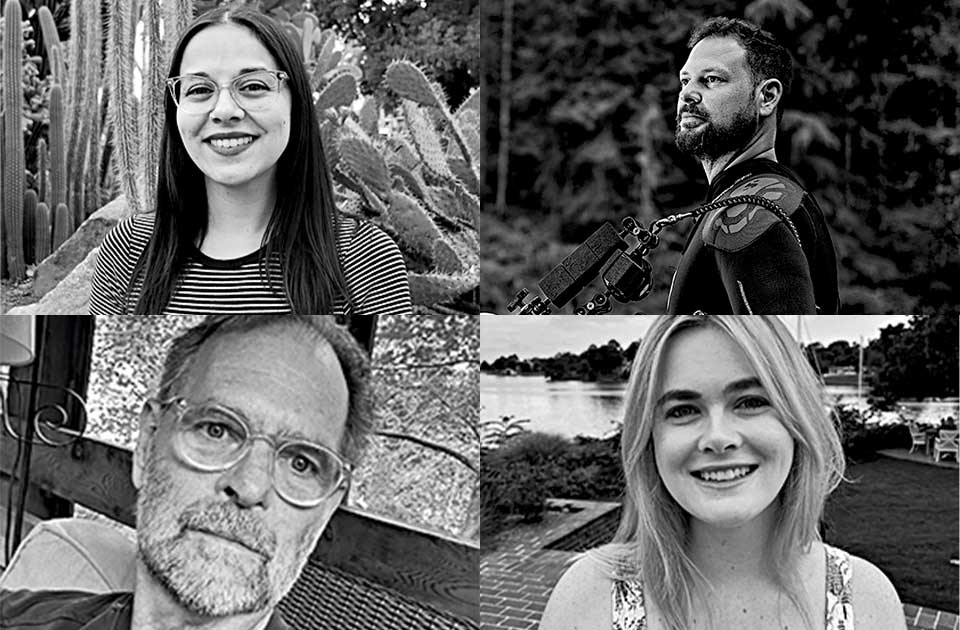
Clockwise from top left: Kate Gonzales (photo courtesy of Kate Gonzales), Shane Gross (photo by Kayla Dalla Rosa), Delaney McPherson (photo by Kylie McPherson), David Whitmore (photo courtesy of David Whitmore)
We are honored to introduce a handful of the contributors who helped make our Fall 2025 issue of National Wildlife® magazine an insightful, inspiring read.
KATE GONZALES lives in Sacramento, California. On “Good Fire: The Case for Cultural and Prescribed Burns”, she says: “I grew up in the region, working for my small-town paper, so bringing this story to a national platform” has been rewarding. “I’d thought of prescribed burns as institutional. But seeing how much collaborative work goes into this feels really good.” See more of her work.
SHANE GROSS, a marine conservation photojournalist based in British Columbia, Canada, first heard about plainfin midshipman (“Plainfin Midshipman: A Face Only a Father Could Love,”) while talking to a scientist from Vancouver Island. “He said he lived near a beach where midshipman breed and could hear them at night. I was like, ‘What?!’ I decided I wanted to learn more.” See his work.
DELANEY MCPHERSON, National Wildlife’s assistant editor, was the ideal reporter for “40-Plus States Submit Wildlife Action Plans This Fall. Here's What That Means,” on the next round of U.S. state and territory wildlife action plans. “For someone who loves trivia, this was a great story,” she says. “I got to talk to the people who are doing the work. I learned some sturgeon don’t start spawning until 20 years old, but then they can live to be 100.” Read more.
DAVID WHITMORE, design director of National Wildlife since 2018, aims to make every story unique. On his map approach to “40-Plus States Submit Wildlife Action Plans This Fall. Here's What That Means,” he says: “It’s a reductive version of the U.S., where each state is an equal size square, presenting the perfect grid. And it’s user interactive, inviting readers to turn the page and find their state, their critter.” Find him on Instagram.