As Seas Rise, So May Wildlife Translocations
Countless plant and animal species are threatened by rising sea levels. For some, translocations may be the only way to avoid the fate of the Bramble Cay melomys.
- By Katarina Zimmer
- Conservation
- Sep 24, 2025
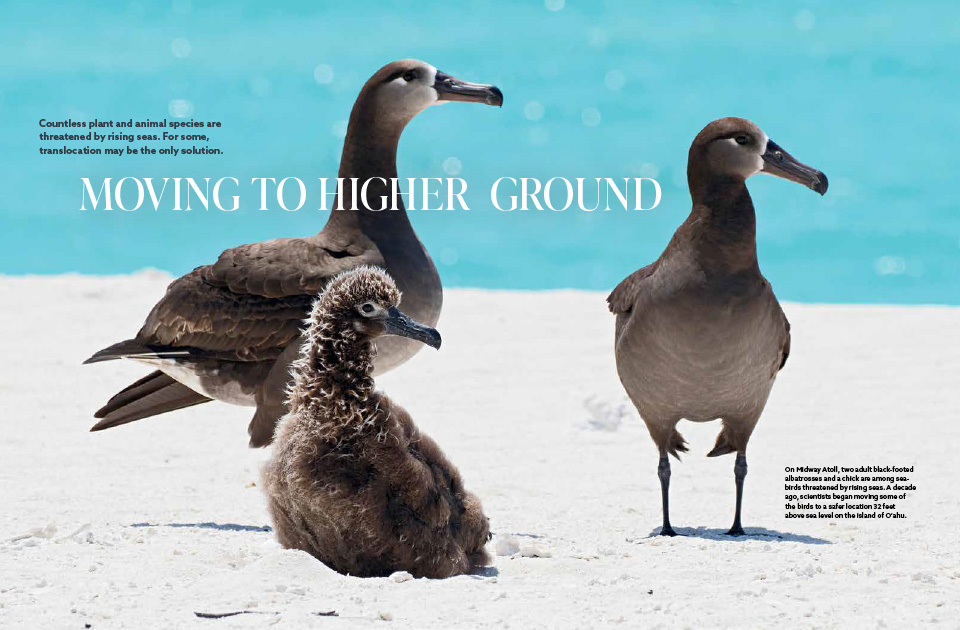
On Midway Atoll, two adult black-footed albatrosses and a chick are among seabirds threatened by rising seas. A decade ago, scientists began moving some of the birds to a safer location 32 feet above sea level on the island of O‘ahu. (Photo by Eric VanderWerf/Pacific Rim Conservation)
AT THE NORTHERN END OF AUSTRALIA’S GREAT BARRIER REEF lies a tiny flat island called Bramble Cay. Barely nine football fields in size and miles away from other land, it’s hard to imagine any animal living here. Yet against all odds, it had been home to a small, ratlike rodent—the Bramble Cay melomys—for thousands of years.
Nobody knows how the melomys got here. Perhaps its ancestors got stuck after wandering over a land bridge connecting the island to Australia during the last ice age or floated down on a raft of vegetation from New Guinea. Somehow, it forged a life on this desolated speck of land, munching on local succulents and hiding out under sea turtle shells.
But its unusual home also made the melomys vulnerable. While scientists estimated there were 93 of the rodents in 1998, by 2004 they found just 12. At fault, experts suspected, was sea level rise, as warmer global temperatures melt polar glaciers and cause heat-absorbing oceans to expand in volume. Along with stronger floods and storm surges, rising oceans led to land loss on Bramble Cay as well as inundation by plant-killing seawater, robbing the melomys of food. After scientists failed to find any of the animals during visits in 2011 and 2014, they concluded the species had gone extinct. “I consider it a real loss,” says Tyrone Lavery, a mammalogist at The University of Melbourne. “For me, it was an important part of our natural history.”
For now, the Bramble Cay melomys remains the only known extinction caused by sea level rise. But rising oceans are continuing to destroy precious habitats along coasts and low-lying islands worldwide. According to the National Oceanic and Atmospheric Administration, average global sea levels already have risen some 9 inches since 1880. And even in the hypothetical scenario where humanity stopped emitting planet-warming carbon dioxide soon, we could see an additional rise of 1.6 to 10.5 feet by 2300. Worst-case scenarios could mean between 6.6 and 23 feet, says the GEOMAR Helmholtz Centre for Ocean Research Kiel in Germany.
Fortunately, conservationists have found ways to move some imperiled species out of harm’s way, from translocating rare tree cacti and threatened seabirds to higher ground to helping entire marshes and their inhabitants shift inland. Moving any plant or animal to safety is no simple feat and requires deep consideration around their long-term survival as well as the risk of upsetting local ecosystems. Yet translocation offers the best survival chance for many species—and indeed, could well have saved the Bramble Cay melomys from extinction, Lavery says.

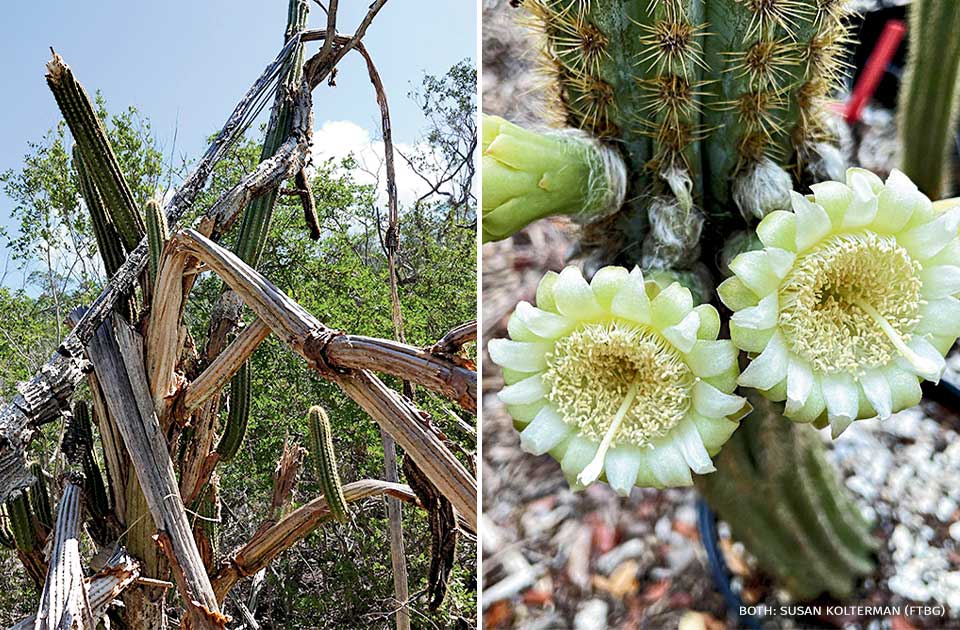
To prevent the species' extirpation from the United States, botanists rescued a dwindling number of Key Largo tree cacti damaged by storms and rising seas (above left), planting them in safe locations (above right) where their flowers are hand pollinated. The original population has died out.
Cacti on the move
Humans have been accidentally moving species around for centuries, often introducing them into foreign habitats where they sometimes devour or outcompete native species. Only more recently have conservationists proposed intentionally doing so to rescue species from human-caused threats. “The magnitude of climate change is so great that I don’t see how we don’t move species around to protect them,” says ecologist Mark Schwartz of the University of California, Davis.
Already, conservationists have rescued one genetically unique plant population in Florida: the Key Largo tree cactus, which grows in tall, green, spiny columns sporting distinctive cottonlike hair clumps. While other members of its species live in the Bahamas, Cuba, Haiti and the Turks and Caicos Islands, the only U.S. population was on a small limestone outcrop in the mangrove forests of John Pennekamp Coral Reef State Park. “It’s a cool part of our natural history,” says botanist Jennifer Possley of the Fairchild Tropical Botanic Garden, who speculates the cactus arrived in the Keys as a seed pooped out by a bird migrating from the Caribbean.
After surviving an attack that was likely by invasive rats in 2015 and a hurricane battering in 2017, rising seas began introducing plant-destroying brackish water that eventually surrounded the bases of the cacti. In 2021, scientists decided to salvage the plants that were left, using saws to cut off 22 healthy parts and carrying them out in buckets.
About half the rescued cacti went to the Fairchild Tropical Botanic Garden in Coral Gables. The rest went to a nursery within the state park, where young cacti are being raised to be planted in a long-term home at a relatively high-elevation spot in the wild. The cacti now have a good chance to survive. Had they not been rescued, the Key Largo tree cactus would have disappeared from the United States: In 2024, the population at its original site was declared extirpated.
Possley’s team also has translocated three more at-risk plant species—all pine rockland herbs—that inhabited low-lying parts of the Keys, much of which is no higher than 5 feet above sea level. In addition, they’re preserving seeds to support future efforts to grow new populations, “because we don’t know … what will need to happen in the future,” she says.
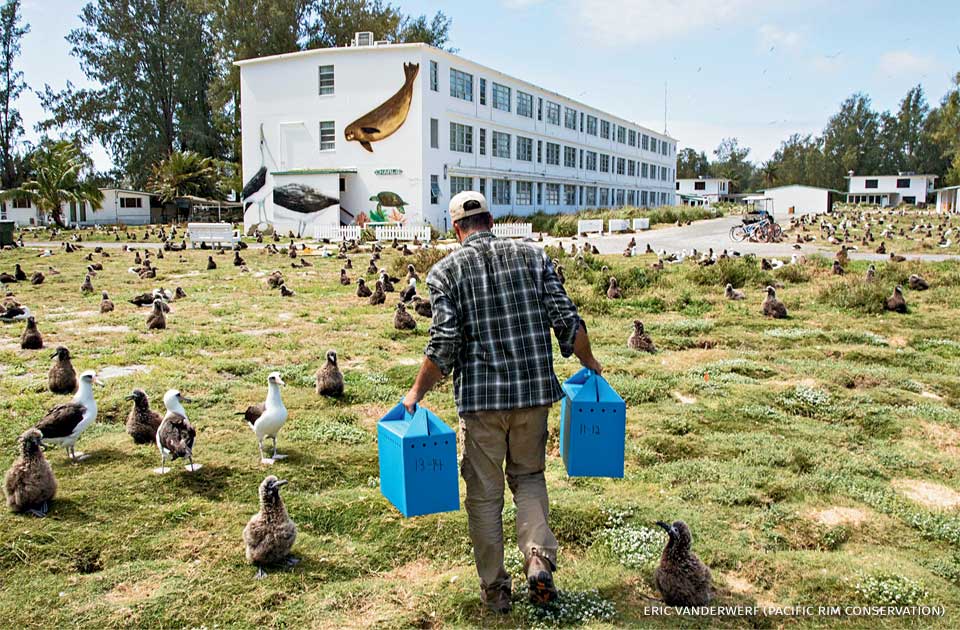
Biologists collect Bonin petrel chicks on Midway Atoll to rescue them from rising seas. Translocated to O‘ahu, 100 birds have returned to that island to raise their own chicks.
Saving drowning seabirds
Compared with plants, moving seabirds is a decidedly trickier business. But on a few low-lying northwestern Hawaiian Islands, ornithologist Eric VanderWerf and his colleagues at the nonprofit Pacific Rim Conservation have reported notable successes. For years, scientists and federal officials had watched increasingly high waves destroy thousands of albatross and petrel nests each year. While adult birds usually fly away, some have such a strong instinct to stay with their eggs or nestlings that they end up drowning alongside them. At the same time, the ocean is swallowing entire nesting grounds. Though many seabirds move to unimpacted areas—often on other islands—it can take them years to do so, and many islands are inhabited by invasive, bird-eating predators. “And it’s possible that some birds may never be willing to go somewhere else,” VanderWerf says.
In 2015, VanderWerf and his colleagues set out to establish a new nesting colony for four seabird species imperiled by rising seas. They selected a site roughly 32 feet above sea level in O‘ahu’s James Campbell National Wildlife Refuge that they had surrounded by a fence to keep out invasive cats, dogs and mongooses.
The challenge with relocating seabirds is that adults habitually nest where they were raised. For example, Laysan albatrosses (designated near threatened by the International Union for Conservation of Nature, or IUCN) must be moved before they turn one month old in order to internalize the location of their new home. So, the scientists took albatross eggs from nests on a military base in Kaua‘i where the birds needed to be moved because they posed an aircraft collision hazard. At three weeks of age, the chicks were placed in artificial nests at the O‘ahu site. Every day for five months, VanderWerf and his colleagues used syringes to squirt a nutrient-rich squid and fish smoothie into the birds’ mouths, mimicking the adults’ regurgitation of seafood.
Already, some of the translocated albatrosses have returned to the O‘ahu site to nest after spending their first four to five years at sea. In a practice called social attraction, the team also has drawn in additional nesting adults by setting out plastic bird decoys and playing recordings of albatross courtship calls. For black-footed albatrosses, whose eggs were taken from the wave-pounded edge of Midway Atoll, 40 of 95 birds raised at the site have returned. Though they’ve seen less success with the Tristram’s storm-petrel, Bonin petrel transplants are doing well, with 100 birds having returned to the site.
VanderWerf is optimistic that they’ve translocated enough seabirds to form a critical insurance population as the birds’ relatives on low-lying islands continue to grapple with sea level rise. “I’m confident we’ve done enough, and the colony will increase and persist,” he says.
Can marshes migrate?
Other species, however, have nowhere safe to go because their entire habitat is at risk. This includes much of the unique fauna that inhabits salt marshes along the U.S. Atlantic coast. For example, a quarter of the world’s saltmarsh sparrows—classified as endangered by IUCN—reside in Maryland, where the effects of sea level rise are exacerbated by topographic flatness and natural land subsidence.
Rather than fraying at the edges, the lower reaches of these marshes are drowning as pools form in their interior. Upper marshes, which usually see seawater only during extreme tides, are becoming increasingly inundated, a process that wipes out eggs and nestlings of saltmarsh sparrows. “It’s the principal mechanism by which their populations are declining now,” by around 9 percent a year, totaling an 87 percent loss since 1998, says ornithologist David Curson of Audubon Mid-Atlantic.
Efforts are underway to rescue the remaining marsh, by digging small runnels to draw off trapped surface water, for instance, or using sediment from clearing nearby shipping lanes to raise the marshes’ height. Another important strategy is helping marshes move inland to keep up with sea level rise. Marshes naturally colonize areas after saltwater intrusion has killed off patches of forest, but sometimes dying trees give way to deep ponds as their roots shrink and the ground around them collapses. To prevent that scenario at one spot in Maryland’s Blackwater National Wildlife Refuge, U.S. Fish and Wildlife Service (FWS) officials removed about 13.3 acres of submerging and dying forests before the trees died, says FWS wildlife biologist Matt Whitbeck, who reports that marsh grasses have colonized the area since the trees were removed.
Another important task is protecting the land that marshes will need to move inland. One strategy that nonprofits, state agencies and land trusts in Delaware and Maryland are working on is to acquire private land and embed it within protected areas or conservation easements—legal structures that maintain land in a natural-as-possible state. The goal is “to make sure that the marsh does have a place to go, and the sparrows and the grasses have the ability to follow that landscape,” says Andrew Szwak, Mid-Atlantic program manager for the Land Trust Alliance.
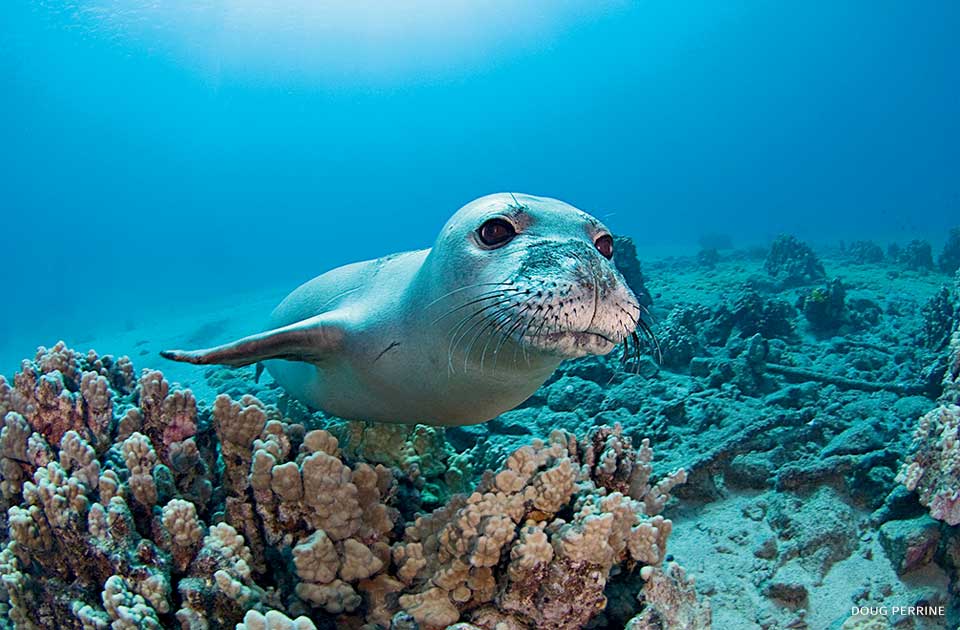
Some species threatened by rising seas, including the Hawaiian monk seal, cannot be translocated because there are no safe locations available.
Translocation versus assisted migration
The long-term success of many such efforts, however, depends on future sea level rise. As even nearby habitats are swallowed by the sea, conservationists will have to look increasingly further afield to move species, and that can spell problems.
Unlike projects so far to save species from sea level rise—where animals are moved to new locations within a species’ historic range—the conservation strategy known as “assisted migration” translocates species beyond their ranges. Because such moves could harm ecosystems that aren’t adapted to the new species—by upsetting delicate food webs or introducing new diseases and competitors—the approach is controversial. “When you make big leaps, that has a higher probability of having damaging effects to the recipient ecosystem,” Schwartz says. “I think we have to be very deliberative and cautious about assisted migration.”
If we do employ the strategy, he says, we either do so quickly and deal with the risks, or we carefully weigh the risks and benefits, which takes time that many species don’t have. It took 20 years, for example, for conservationists to finally translocate the sihek, a kingfisher that had gone extinct on the island of Guam and was being kept in captivity, to a safer Pacific island. “We don’t have the resources to take that kind of time and care and attention to the thousands of species that probably need moving,” Schwartz says.
Such resources could be even harder to come by in the future. Translocation efforts are typically paid for through federal funding, state governments or nonprofits—but some of those sources, like the U.S. federal conservation budget, recently got smaller, Schwartz notes. And “as the problem gets larger, financing will get harder,” he adds.
For some species, translocation may not be a viable option at all. On several northwestern Hawaiian Islands, for example, populations of the federally endangered Hawaiian monk seal are threatened by rapidly rising seas. Three islands that were popular seal birth sites already have vanished. While seals so far have been able to move to other islands, what happens if those also disappear? Some have suggested moving the animals to higher-elevation islands like Kaua‘i or O‘ahu, but those already host many monk seals, says marine biologist Jason Baker, a scientific advisor to the Marine Mammal Commission. “There’s no unoccupied habitat that’s available and could sustain a lot more seals,” Baker says. A better solution, he believes, would be trying to save vanishing islands by strategically depositing sand or placing rock or concrete protrusions along shorelines to accumulate and retain sand.
The same is true for the silver rice rat, a native rodent adapted to life in the mangrove-studded islands of the Florida Keys. As sea levels rise, the rats are moving on their own to higher-lying parts of the Keys, but they’ll eventually bump up against roads, holiday homes and other developments, says ecologist Paul Taillie of The University of North Carolina at Chapel Hill. The only survival option he sees may be humans eventually retreating from some of these areas.
Indeed, translocation is no panacea for all species threatened by rising seas. But scientists say that efforts so far demonstrate that, in some cases, we can avoid the sad story of the Bramble Cay melomys from repeating itself. While translocation “certainly needs to be used wisely,” VanderWerf says, “this is an important technique that I hope is used more.”
Katarina Zimmer is a Berlin-based science journalist.
More from National Wildlife magazine and the National Wildlife Federation:
How Hula Is Shifting Alongside Hawai‘i’s Endangered Species »
The Art of Social Attraction »
The Myth of Climate Havens »