Keeping Kit Foxes on Campus
Faculty and students at California State University, Bakersfield, have a plan to bolster the population of endangered San Joaquin kit foxes who call the school home
- Text By Brittany Oceguera // Photos By Anton Sorokin
- Conservation
- Sep 23, 2026
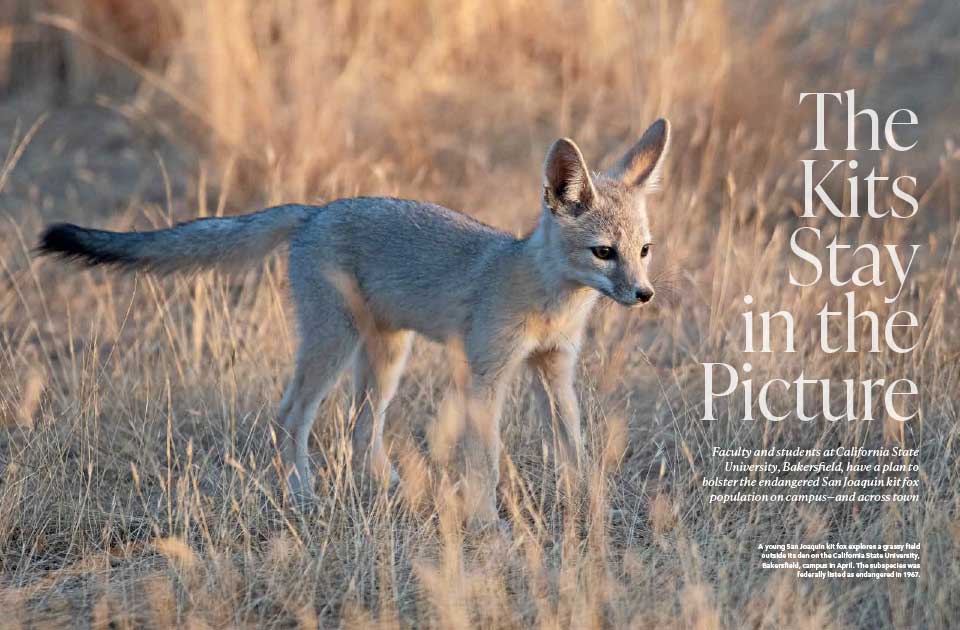
A young San Joaquin kit fox explores a grassy field outside its den on the California State University, Bakersfield, campus in April (above). The subspecies was federally listed as endangered in 1967. A young San Joaquin kit fox briefly pokes its head up from its den (below) at CSUB during daylight. Juveniles typically emerge in the evening.
WHILE IT’S NOT UNUSUAL TO SPOT A SAN JOAQUIN KIT FOX scampering across the campus of California State University, Bakersfield (CSUB), every sighting is a relief to the faculty, staff and students helping conserve the creatures.
With large ears that help dissipate heat in the desert climate, the San Joaquin subspecies once thrived throughout central California. But with development carving out some 90 percent of the fox’s historical range, the total number of individuals now stands at about 3,000, down from as many as 15,000 in the early 1970s.
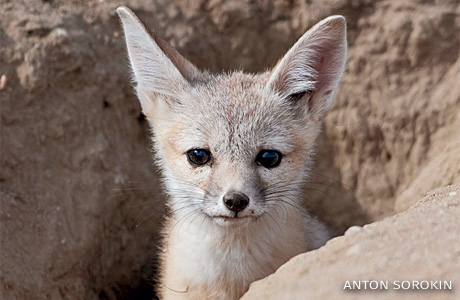
“Our community in Bakersfield, they’re very aware that kit foxes have been here in the past,” says Antje Lauer, a biology professor leading the school’s conservation effort. “When the pups come out of their dens”—typically in April and May, to begin learning how to hunt from their parents—“they’re so adorable. People love them.”
That popularity hasn’t translated into municipal protections, however. Named to the federal endangered species list in 1967, the San Joaquin kit fox today is limited to four core populations: three on the rural west side of the San Joaquin Valley and the urban Bakersfield group, or skulk, whose territory includes CSUB.
The kit foxes “are not gaining any habitat,” says Lucas Hall, a Bakersfield biology professor collaborating with Lauer. “If anything, they’re only losing habitat as agricultural and energy development industries continue to expand.”

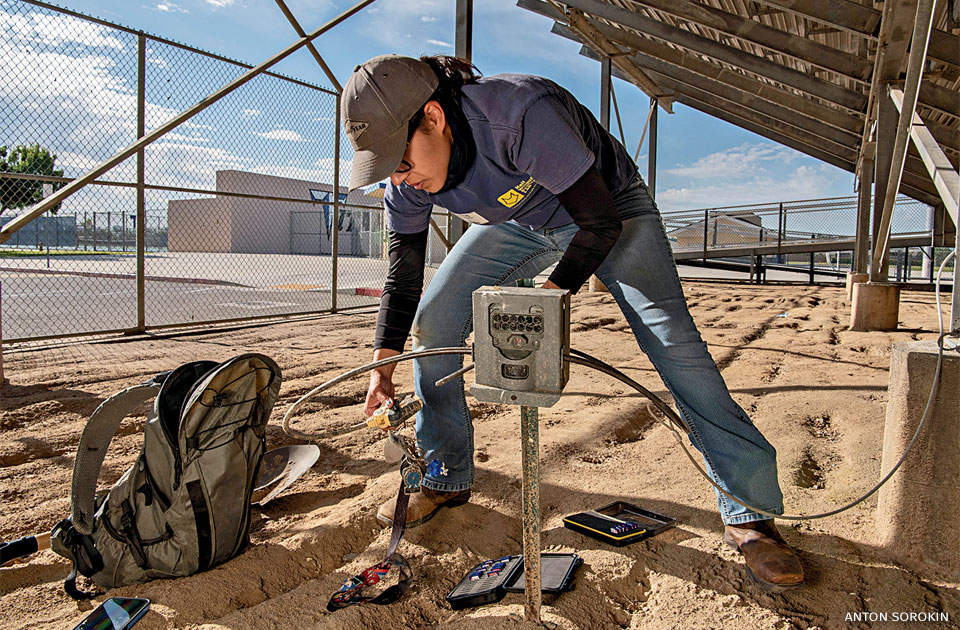
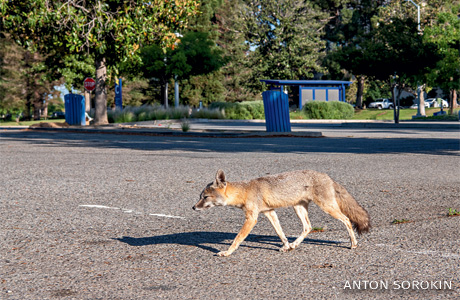
Alyse Gabaldon (pictured), a graduate student studying with Lucas Hall, checks a camera trap set up near an artificial den at a local high school—part of a project to understand behavioral differences between urban and nonurban foxes. An adult kit fox (below) traverses CSUB, likely looking for prey or food scraps.
In response, Lauer and Hall developed a campus conservation model that could be scaled up to protect key habitat citywide. Since 2022, Lauer and her students have been collecting scat around campus and elsewhere in the city then extracting DNA to confirm whether it belongs to the foxes. Knowing where kit foxes den—and where they don’t—could help pinpoint locations where no further development should occur. The noninvasive method doesn’t involve traps or taking blood samples, and the team plans to use it in the future to track diseases, including mange, that can be deadly.
During his first semester as a biology graduate student in fall 2025, Julian Calvillo took “Advanced Topics in Biology” with Lauer, helping with scat collection and subsequent DNA analysis. But progress slowed as the project ran low on funding. A 2025-26 grant from “Mutual of Omaha’s Wild Kingdom” and the National Wildlife Federation to CSUB—a federally designated Hispanic-Serving Institution, with nearly 70 percent of undergrads identifying as Hispanic/Latino—injected new hope. (See “NWF Priority,” bottom.)
“We kind of got a second wind and were able to get back to work,” says Calvillo, who collects scat from the outskirts of Bakersfield once a week, covering long distances on foot and noting where he picks up each sample. While he calls fieldwork as simple as “walking around, looking for poop on the ground,” Calvillo is enthusiastic: “I like being outdoors.”
Although the foxes’ main food source is small rodents, they’re opportunistic, Lauer says. “It’s so easy to go after a little piece of pizza or chicken” from fast-food outlets on campus. While some urban foxes have shown higher cholesterol levels than nonurban, Lauer says scavenging is less harmful than eating rats or mice that have ingested a rodenticide.
Despite the threats of city living, from diet changes and rodenticides to ongoing habitat loss to potential collisions with cars, the Bakersfield foxes have longer life spans and are more genetically diverse than the rural San Joaquin kit foxes, Lauer and Hall have learned through their research.
“The population here in the city has been remarkably adaptable,” Hall says.
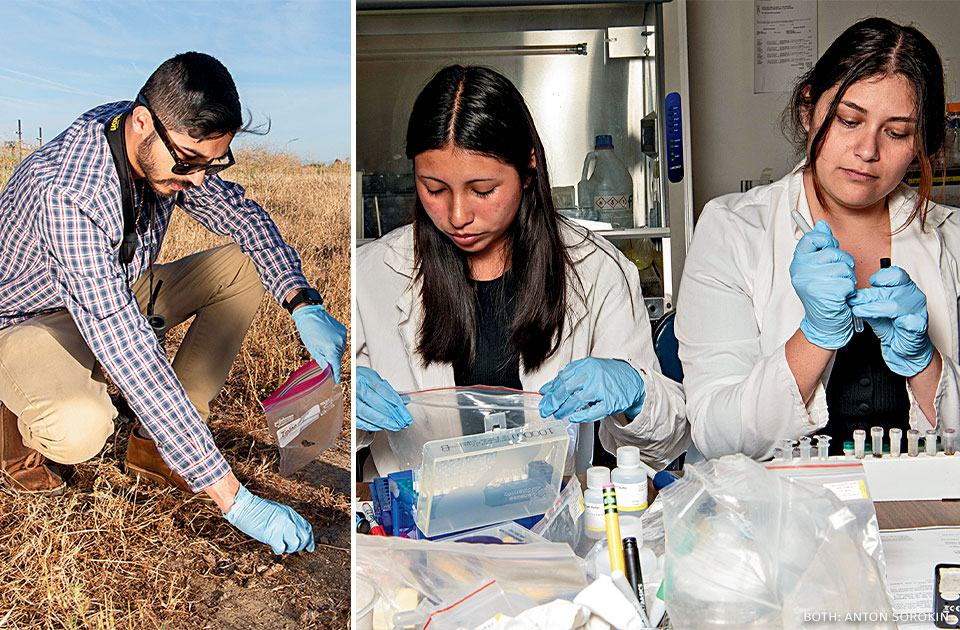
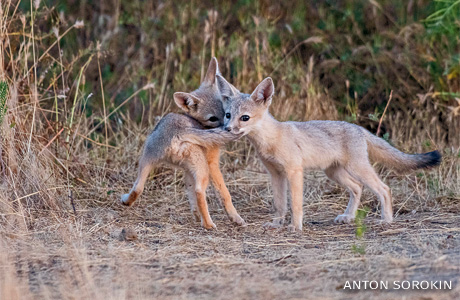
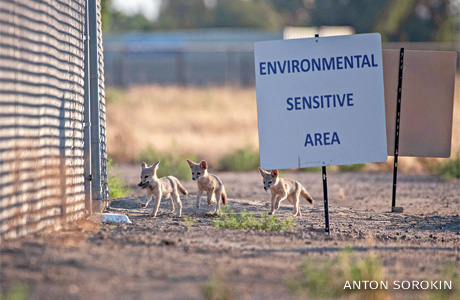
Francisco Ruiz Ponce (pictured, left) and other students in Antje Lauer’s course “Advanced Topics in Biology” collect scat samples at CSUB during the spring 2026 semester. Odett Toscano, then a first year, and Guadalupe Higareda, then a senior (pictured, right), process samples in the lab. Young San Joaquin kit foxes (below) play near their den. A sign on campus (bottom) helps ensure students and grounds crews give the dens a wide berth.
While working two jobs and finishing up her senior year as a full-time biology major, Guadalupe Higareda volunteered four hours a week over the spring semester to help process scat samples. In a small lab across from Lauer’s office, she puts on music and gets to work, removing samples from tubes and breaking them down before adding a buffer solution that helps isolate DNA.
“I find it really interesting—the fact that it’s hands-on work that you actually get to see,” Higareda says. “As a student, you learn about these things, but you don’t really get to apply them to the real world.”
Odett Toscano, a first-year student, is working in a lab for the first time. “I want to go to med school, so I want to get more experience in research,” she says. Her favorite aspect of the work is learning what species the scat belongs to.
For Calvillo, the trial-and-error aspect still presents a learning curve. “There are plenty of cases where something fails, and you cannot be sure which part [it was] until you do it all over again,” he says, citing variables from not extracting enough DNA to the polymerase chain reaction technique the team uses not amplifying DNA properly.
“So when it works and you get the result back that you’re looking for, yeah, that’s the good part,” he says.
Lauer and Hall hope public education—and a sense of ownership in the foxes’ future—could spur conservation off campus, as well.
“Preservation of the endangered San Joaquin kit fox is a moral imperative at CSU Bakersfield, and the entire campus community has rallied around the effort to live responsibly alongside the other species that inhabit this beautiful land,” Jennifer Self, the university’s senior director of strategic communications, wrote in a statement. “Dr. Lauer has championed kit fox preservation, both at CSUB and throughout our community, and her advocacy is making a difference.”
Lauer says she has reached out to the city about adopting the school’s data collection methods and is waiting to hear back. “Our consultant is still working on the [habitat conservation plan draft] thus the actual details have not been decided,” Phil Burns, the city’s development services director, emailed in response to an inquiry from this magazine.
“We wanted to show the city we can get data quickly and make a conservation plan,” says Lauer, who believes the method, applied at a larger scale, could help Bakersfield identify areas “that should not be developed.”
Otherwise, she says, “with the development of CSUB and Bakersfield, [the kit foxes] will probably decline.”
NWF Priority
Rewilding Campuses
In the grant program’s second year, seven colleges and universities received 2025-26 funding from “Mutual of Omaha’s Wild Kingdom” and the National Wildlife Federation. Wildlife beneficiaries included San Joaquin kit foxes at CSUB, northern long-eared bats at Allegheny College, brown-headed nuthatches at Georgia State University’s Perimeter College, red-headed woodpeckers at Kentucky State University, eastern rat snakes at Smith College, gopher tortoises at the University of South Florida and freshwater mussels at the University of Tennessee. Read more.
Read about the writer and recent CSUB alumna Brittany Oceguera and photographer Anton Sorokin.
More from National Wildlife magazine and the National Wildlife Federation:
Rodenticides' Collateral Damage »
Blog: Campuses Receive Wild Kingdom Grant Award to Protect Endangered Wildlife »