When Algae Bloom, Business Withers
Harmful for the environment, algal blooms—in freshwater streams and along coastlines—also erode the recreation economy
- By Katie Hill
- Conservation
- Jun 24, 2026
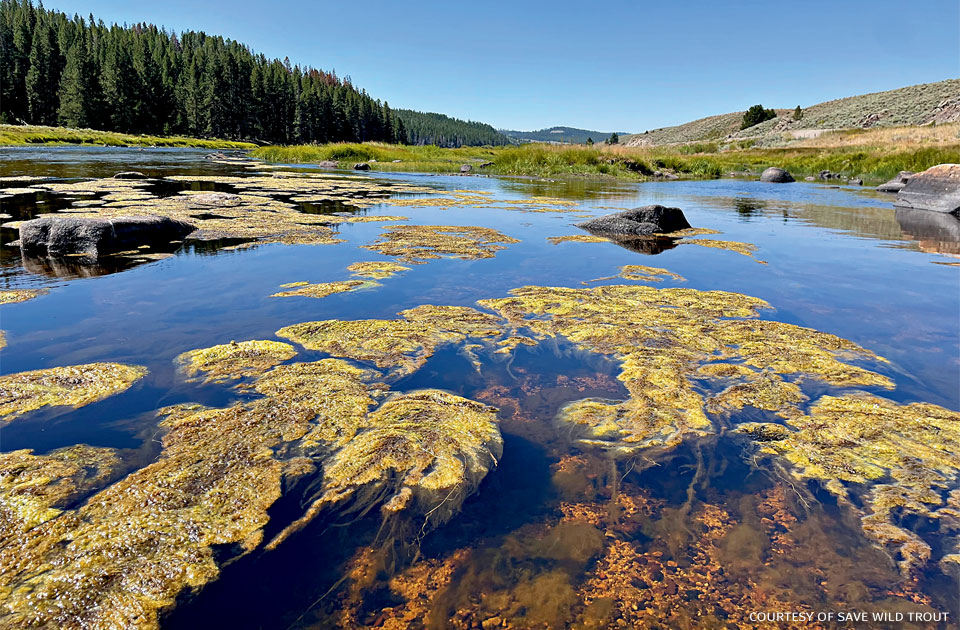
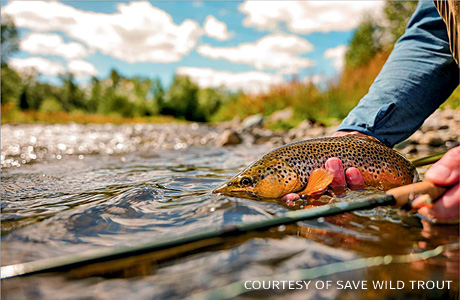
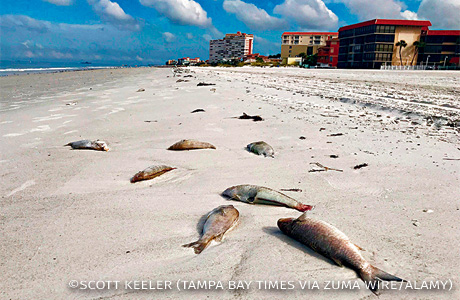
A 2025 algal bloom on Montana’s Big Hole River (above) limited angling for brown trout (below, on the Big Hole in a healthier year) and ate into industry profits. In 2018, a red tide deposited dead fish on Florida’s North Redington Beach (bottom).
WITHOUT HEALTHY TROUT in the Jefferson River basin, Shaun Jeszenka’s fly-fishing business would be dead in the water. Jeszenka owns Frontier Anglers in Beaverhead County, Montana, an area that boasts a wealth of opportunity for anglers, paddlers, waterfowl hunters and wildlife enthusiasts.
But Beaverhead County is also home to Montana’s biggest livestock economy, an industry that takes a lot of water. According to county-level water use data from the U.S. Geological Survey, county residents diverted over 830 million gallons of surface water per day for livestock and crop irrigation in 2015, leading the state and ranking fifth nationwide. When this already scarce water ends up back in rivers and streams, it’s often dense with nutrient pollution from manure and fertilizer runoff—conditions that resulted in a notably early algal bloom in 2025. Anglers, paddlers, environmentalists and biologists watched in horror as an emerald cloud spanned a 25-mile stretch of the Big Hole River near the town of Twin Bridges before the end of June. It was one of 58 algal blooms confirmed by the Montana Department of Environmental Quality last year.
“You go out there in April and May, and it’s just rocks, cold water, and everything’s fine,” Jeszenka says. “Then the river drops as irrigation demand [for feed crops] reaches its peak. Snowpack is gone. The river turns bright green, with 6 to 8 inches of algae growing on the bottom.”
As covered in this magazine and elsewhere, freshwater and saltwater algal blooms—whether in a Montana trout stream, along a Florida coastline or in a Massachusetts lake—create severe health and environmental problems. Toxic algal blooms, commonly referred to as harmful algal blooms (HABs), are especially troubling, turning the water into a sickening sludge for all creatures, humans included. A stroll along an HAB-impacted waterfront can cause headaches and asthma-like symptoms. Consuming water or contaminated fish can trigger vomiting, diarrhea, bloody urine, fever and more. As climate change drives blooms to start earlier and increase in frequency, the impacts could get worse.
“This is happening due to a combination of factors,” says Alisha Renfro, a coastal scientist with the National Wildlife Federation. “Nutrients enter the system at higher levels than they have in the past ... which feeds microscopic [algae] in the water, causing them to grow. In warming waters, that algae grows even faster.”
The negative outcomes of algal blooms don’t stop with health and ecological complications. Beach and lake closures, shortened guiding seasons and canceled reservations are quick to follow, carrying a massive price tag. Jeszenka, a member of the Fishing Outfitters Association of Montana, estimates that Frontier Anglers and other guiding services in the state have suffered a 30 to 40 percent decrease in business over the last three years due to water quality issues.
“Even if a bloom isn’t toxic, it can still be very damaging,” says Don Anderson, a biologist and director of the U.S. National Office for Harmful Algal Blooms. He explains that over 1,000 species of algae can bloom in fresh, salt and brackish waters. These buildups shade the water from sunlight, impacting submerged vegetation.
“When all that biomass decays, bacteria degrades those cells,” he continues. This process causes the bacteria to “strip the water of oxygen,” triggering “hypoxic events.” If fish aren’t poisoned to death, they asphyxiate in the oxygen-starved water.
All this carnage would be enough to drive tourism away, if managers haven’t already closed down public access points. When Tully Lake in Royalston, Massachusetts, experienced an HAB in 2018, The Trustees of Reservations—a Massachusetts-based nonprofit that manages a campground at the lake—experienced up to 170 reservation cancellations, amounting to $6,290 in lost revenue, according to a representative.
When scaled up to a toxic red tide event in a coastal area that relies on tourism and commercial fishing, the economic losses are “roughly equivalent to those of a hurricane,” according to Anderson. A study published in 2024 in Journal of Environmental Management put the impact of a 2018 red tide on coastal tourism in Florida at $2.7 billion.
“People hear there’s a red tide in Florida and they might go to Disney World rather than going to the coast,” Anderson says.
Response to coastal HABs has improved in recent years, Anderson says. The National Oceanic and Atmospheric Administration officially launched its Florida red tide forecasts in 2021. Scientific innovations include a submersible microscope that can take hundreds of thousands of high-resolution images of algae per day and use artificial intelligence to identify the species photographed.
Changes are happening on the ground, too, according to Duane Hovorka, a senior agriculture policy specialist with NWF.
“Incentives and conservation programs help farmers and ranchers be better stewards of the land,” he says. “Farmers realize they’re wasting money and killing off beneficial bacteria and fungi” with overuse of pesticides. “The good news is, with healthier soil, farmers can maintain yield with less fertilizer and pesticides, and even do better in dry years. It also helps keep our rivers healthy.”
Local communities have gotten involved as well. After Montana slackened its nutrient pollution standards in May 2025, leaders of the Confederated Salish and Kootenai Tribes, among others, sued the U.S. Environmental Protection Agency to enforce the Clean Water Act. Still, concerns remain.
“I wish I were more positive,” Jeszenka says. “I keep thinking Mother Nature will throw us a bone, and we’ll have some big water years.” So far, he says, “it doesn’t look like that’s happening.”
Katie Hill is a freelance environmental journalist and writer based in Missoula, Montana.
More from National Wildlife magazine and the National Wildlife Federation:
New Challenges Are Roiling the Great Lakes »
Harmful Algal Blooms Threaten Both Wildlife and People »
Blog: Harmful Algal Blooms in Lake Erie »