Rock Art Offers a Portal to the Past and the Present
The Three Rivers Petroglyph Site and other bastions of Indigenous rock art offer glimpses into history and connections to today
- By Jennifer Wehunt // Artwork Attributed to the Jornada Mogollon People // Photograph by Stephen Alvarez
- Conservation
- Jun 24, 2026
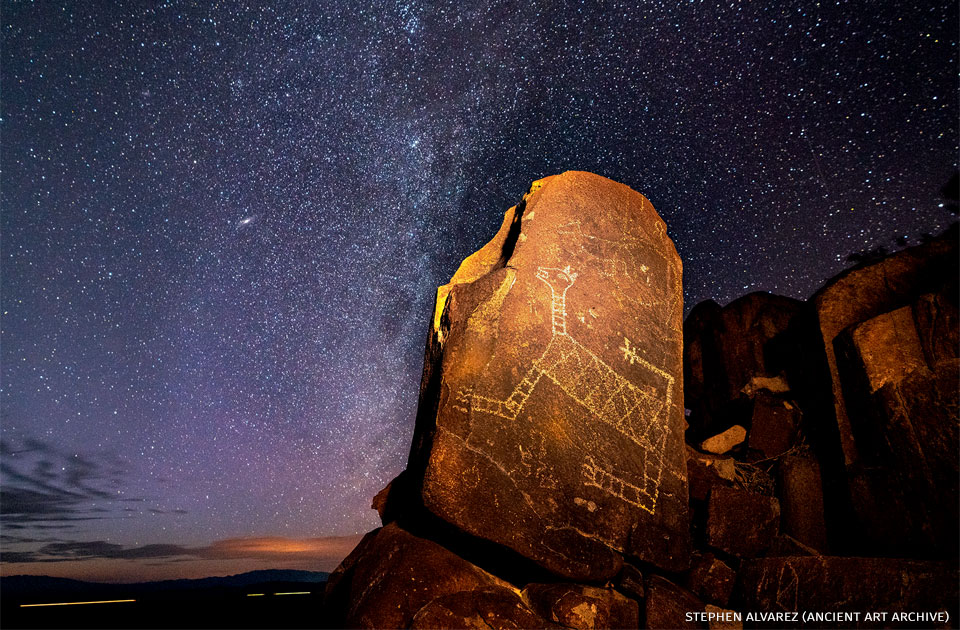
THREE RIVERS PETROGLYPH SITE (above), in what is now New Mexico, “exhibits a thing we call persistence of place,” says photographer Stephen Alvarez. “It becomes important in deep history and stays important.” While this particular artwork is attributed to the Jornada Mogollon people, circa 200 to 1450 C.E., according to the federal Bureau of Land Management (BLM), the area bears much older human traces. “People had already been flourishing on this continent for 20,000-plus years” when someone crafted this work, Alvarez says. His 2020 image of it appears in his collection Rock Art: An American Story, published in April by Ancient Art Archive, a nonprofit he founded in 2016. Kate Nelson, an Alaska Native Tlingit Tribal member and the book’s editor and writer, notes that Three Rivers, operated by BLM and home to scores of millennia-spanning images, is open to the public, “making it an example you can go witness for yourself.” For Alvarez, the works sit within their own context of time. “Looking at rock art, you’re looking into the past. But when you look at the night sky, you’re looking into the past, too.” Light visible in this photo left Andromeda 2.5 million years ago, he says, “So, you’re not seeing Andromeda. You’re seeing the past”—as well as the present. “There’s a tendency to think of us as always being relics,” Nelson says. “But Native American communities are still here.” Learn more.
More from National Wildlife magazine and the National Wildlife Federation:
Nuclear Testing Continues in Nevada. Western Shoshone Want It to Stop. »
Cannupa Hanska Luger’s Ode to What Remains »
Singing Double: A Neon Horizon from Artist Marie Watt »
See Last Issue’s Featured Artist »