New in Wildlife Science: Monarch Migration, Rafting Iguanas, Echolocation
What it might mean that monarchs are delaying fall migration, how iguanas made it from the Americas to Fiji and how bats conquer a ‘cocktail party nightmare’
- By Laura Tangley
- Wildlife Science
- Sep 24, 2025
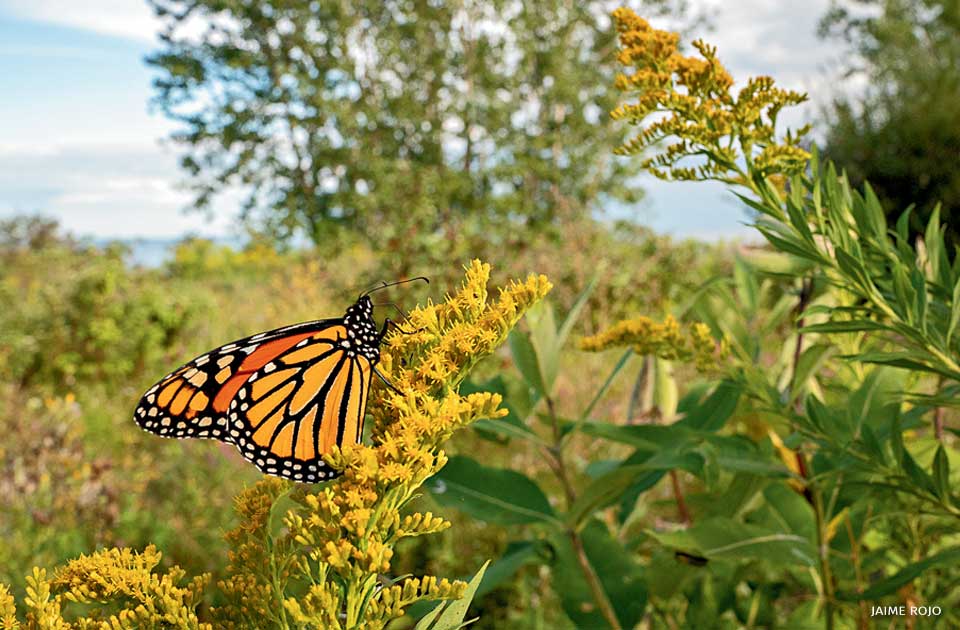
Monarchs Delay Fall Migration
As the global climate heats up, some species are shifting the timing of seasonal events to keep pace—with animals breeding or migrating sooner and plants leafing out or flowering earlier. Because species do not shift in tandem, potential mismatches between interdependent species are a concern. To find out if such phenological shifts are occurring among monarch butterflies (above) or their milkweed host plants at Iowa’s Camp Dodge military installation, biologists analyzed observations of monarch arrival and departure dates collected between 2003 and 2019. They also reviewed long-term data on the bloom time of the region’s common milkweed plants. In the Journal of Animal Ecology, they report that while the timing of milkweed flowering and monarch arrival in spring had not changed—keeping the species in sync—milkweeds were blooming later and monarchs staying longer at the end of the season, delaying their fall migration to Mexico by an average of nine days. The study’s lead author, Montana State University ecologist Diane Debinski, says this longer breeding season “could have benefits, and it could also have costs” to declining monarchs. Costs might include exposure to late-season predators and parasites or monarch eggs laid too late to complete development.
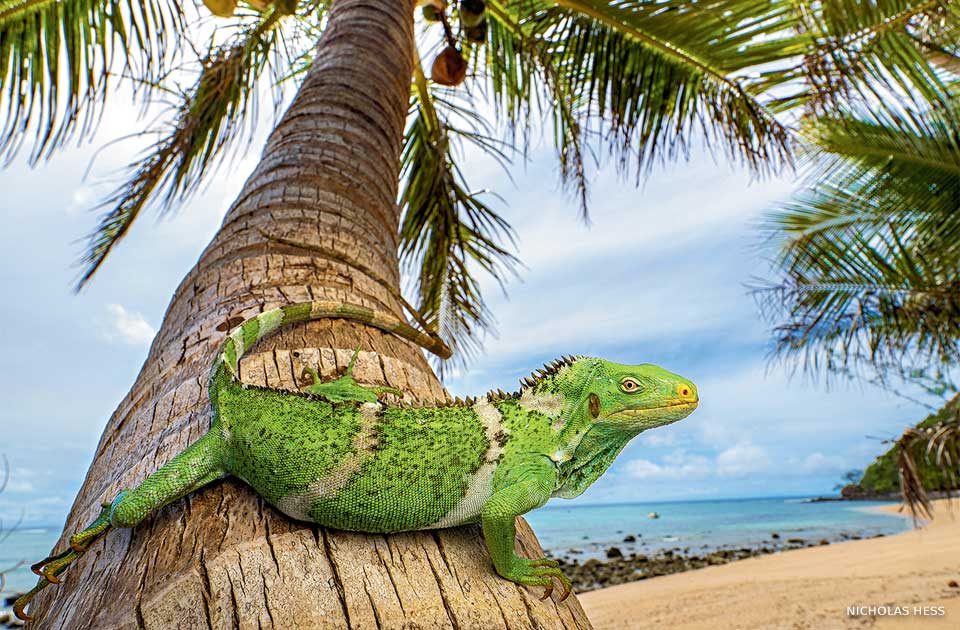
Rafting Iguanas
Four iguana species endemic to the Fiji Islands (including the Fiji crested iguana, above) have long been an enigma. The only native iguanas outside the Americas, how did the reptiles get to this remote South Pacific archipelago? One popular theory held that Fiji iguanas are descendants of an extinct iguanid lineage once widespread in the Pacific. But a new genetic analysis by biologists at the University of California, Berkeley, and University of San Francisco (USF) shows that the reptiles are closely related to North America’s desert iguanas. Publishing their findings in the Proceedings of the National Academy of Sciences, the scientists say the two lineages likely separated 34 million years ago. Their results also suggest that ancestors of Fiji iguanas rafted 5,000 miles across the Pacific from western North America—the longest presumed transoceanic dispersal of any land animal. “Iguanas and desert iguanas, in particular, are resistant to starvation and dehydration. … [I]f any group of vertebrate could make a [5,000-mile] journey across the Pacific on a mass of vegetation, this would be the one,” says lead author and USF herpetologist Simon Scarpetta.
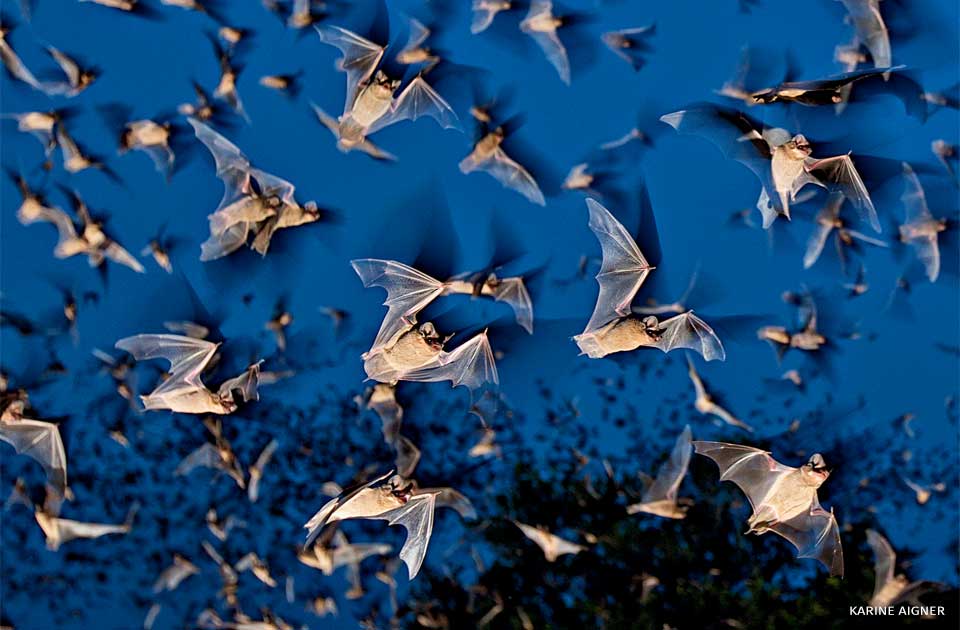
How Bats Conquer a ‘Cocktail Party Nightmare’
In many bat species (such as Mexican free-tailed bats, above), thousands to hundreds of thousands of individuals emerge from daytime roosts simultaneously each night, creating what scientists have dubbed a “cocktail party nightmare” of clashing echolocation calls. To shed light on how the animals deal with this sensory challenge, scientists from Tel Aviv University and the Max Planck Institute of Animal Behavior attached tiny trackers and microphones to greater mouse-tailed bats emerging from a cave in Israel. Computer modeling of their data, reported in the Proceedings of the National Academy of Sciences, reveals that an emerging bat quickly increases its distance from the center of the group and adjusts echolocation calls to be more sensitive to nearby objects. “Imagine you’re a bat flying through a cluttered space,” says co-author Omer Mazar of Tel Aviv University. “The most important object you need to know about is the bat directly in front.”
Microscope
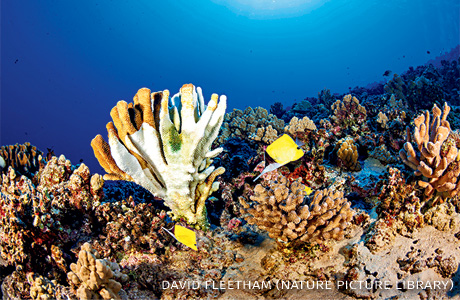
Record-Breaking Coral Bleaching
In a spring 2025 status update, federal marine scientists report that the world’s corals are losing their color (pictured)—and thus their vital symbiotic algae—at an unprecedented scale, with 84 percent of reefs across 83 countries impacted to date.
More from National Wildlife magazine and the National Wildlife Federation:
A Monarch Migration Timed to Mexico’s Day of the Dead »
Climate Change Causes Mismatches Between Wildlife Species »
The Race Is On to Rescue Remaining Coral Reefs »