Noise Pollution Is Disrupting Wildlife
Many wildlife species depend on sound to survive and thrive. What happens when human-caused noise pollution drowns it out?
- By Katarina Zimmer
- Conservation
- Sep 23, 2026
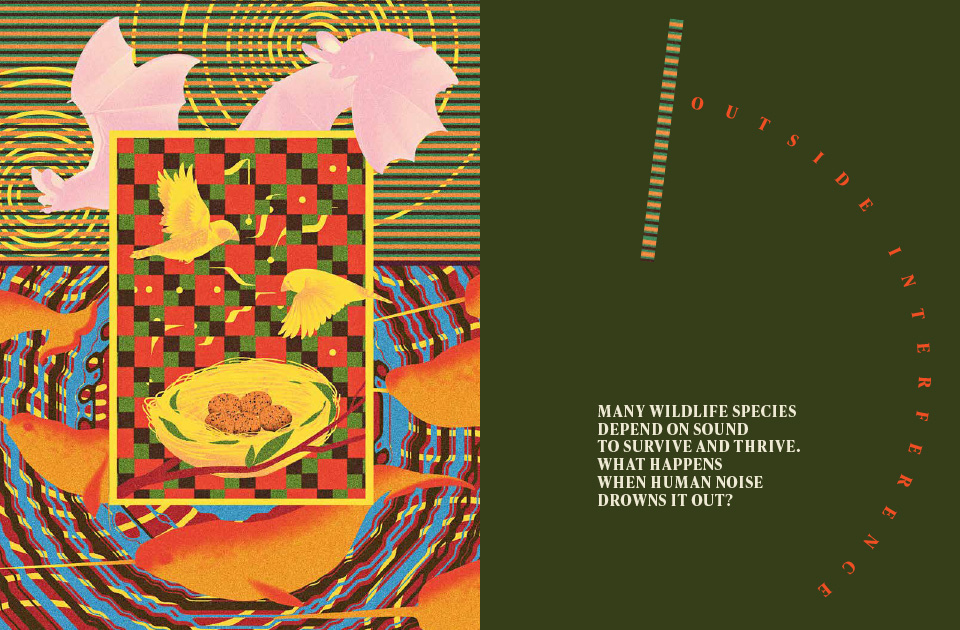
Illustration by Raven Jiang.
AS DARKNESS SETS OVER A BARREN, LIFELESS REEF off Feridhoo Island in the Maldives, a long-lost sound begins to play. From solar-powered underwater speakers mounted inside 4-foot-tall 3D-printed structures that mimic the textured skin of coral, a recording emerges: The whistles of striped dolphins cut across a background crackle that sounds like bacon frying but is actually the clicking of snapping shrimp. Soon deep grunts from squirrelfish, chirping from damselfish and thumping noises from triggerfish join in. The chaotic melody is the sound of animals communicating, cooperating and calling mates. It is the music of life on a healthy coral reef.
In early 2026, scientists began playing this recording—captured from thriving reefs nearby—on Feridhoo’s degraded reefs, where many corals have died off due to heat waves and the physical damage and other disruptions of onshore construction. Alongside scientists’ efforts to restore coral by planting fragments from healthier colonies, marine biologist Antonio Beggiato of Italy’s University of Padua and his colleagues are using sound to attract fish that boost coral growth by nibbling on coral-smothering algae. While Beggiato still is analyzing data from the experiment, he estimates he’s seen about 50 percent more fish—mostly damselfish and wrasses—on the reef since the recordings began, evidently following the sounds of their relatives and neighbors. “By playing the sound of healthy reefs into the degraded colonies, we bring life back,” says Marco Barotti, a Berlin-based artist who created the sound-playing sculptures for the project.
Experiments like Beggiato’s are showing us how vital nature’s music is. But such natural soundscapes increasingly are under threat—and not just due to the declining health of ecosystems. From the drone of ferries and fishing boats around Feridhoo to the roar of airplanes, vehicles, and industrial and extractive activities like mining elsewhere, human noise is drowning out the voices of wildlife.
While it’s long been known that chronic noise is harmful to human health—raising the risk of heart disease and mental health problems like anxiety and depression—scientists increasingly are realizing that it’s bad for wildlife as well. They’re learning that noise can interfere with animals’ ability to find mates, communicate, escape predators and find prey. It can even make habitat unlivable. And just like for people, noise causes stress, impairing wildlife health, reproduction and survival.

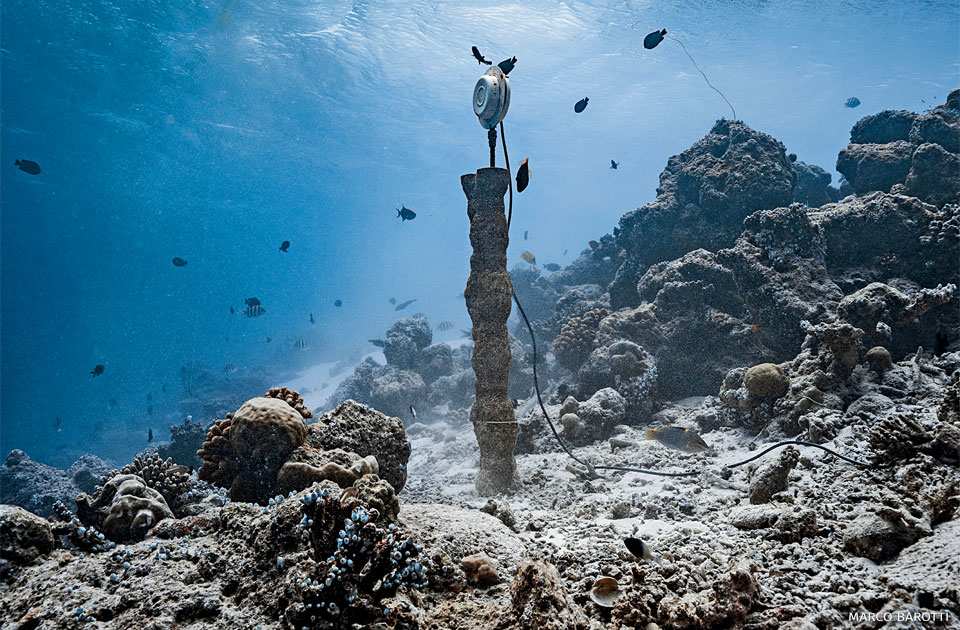
To help restore a degraded coral reef, speakers atop a sculpture in the Indian Ocean broadcast natural sounds recorded on healthy reefs nearby.
Escaping noisy habitats
Not all animals are equally affected by noise. After all, many wildlife species—such as raccoons and foxes—thrive in cities despite the racket. But many small animals like songbirds, bats and insects, which rely more heavily on sound, do not do well with noise, says conservation scientist Jesse Barber of the American Museum of Natural History.
That was made clear in a study published in 2026 in Proceedings of the Royal Society B: Biological Sciences, where scientists reviewed previously published research on 160 bird species, from tree swallows to wood larks, worldwide. They found that noise pollution has been a significant cause of stress and substantially reduces rates of avian reproduction, says co-author Natalie Madden, a conservation scientist at the nonprofit Defenders of Wildlife. She and others see noise as a real hazard to wildlife species that already are dealing with threats such as climate change and habitat destruction, underscoring an urgent need to find ways to reduce noise pollution. Otherwise, Madden cautions, “the impacts to reproduction could likely have effects on population sizes down the road.”
Noise is so detrimental that birds may avoid it, Barber learned when he and his colleagues set up speakers along a ridge in southwest Idaho. By playing traffic noise, they created a “phantom road” in the wilderness during the fall migration of songbirds such as ruby-crowned kinglets and yellow warblers. These migratory birds began to shun the phantom road, says Barber. He and his colleagues counted 31 percent fewer birds during traffic noise playbacks compared to quiet periods, they reported in 2015 in Proceedings of the National Academy of Sciences.
Noise pollution’s impact on birds can have downstream effects on plants, says Jennifer Phillips, an ecologist at Washington State University. Previous research in a New Mexico pinyon-juniper woodland, for example, found that Woodhouse’s scrub-jays—which disperse pinyon seeds—avoided loud sites near noisy gas well compressors. As a result, those locations had fewer pinyon seedlings. In a more recent study, published in Proceedings of the Royal Society B: Biological Sciences, Phillips and her colleagues report that jays appeared to avoid the formerly loud areas even after the compressor noise had been removed, resulting in a continued reduction in pinyon seedling numbers.
The scientists also found shifts in species makeup among wildflowers and shrubs that rely on pollinating insects to reproduce, suggesting that certain insects may have avoided the noisy areas as well. Because they live in the soil, which transmits noise vibrations, and use sound waves to navigate, the Andrenidae family of solitary bees might be especially sensitive to noise, Phillips says. “It could be [preventing] them from wanting to even live in the area if they’re being disturbed by the vibrations of noise,” she says.
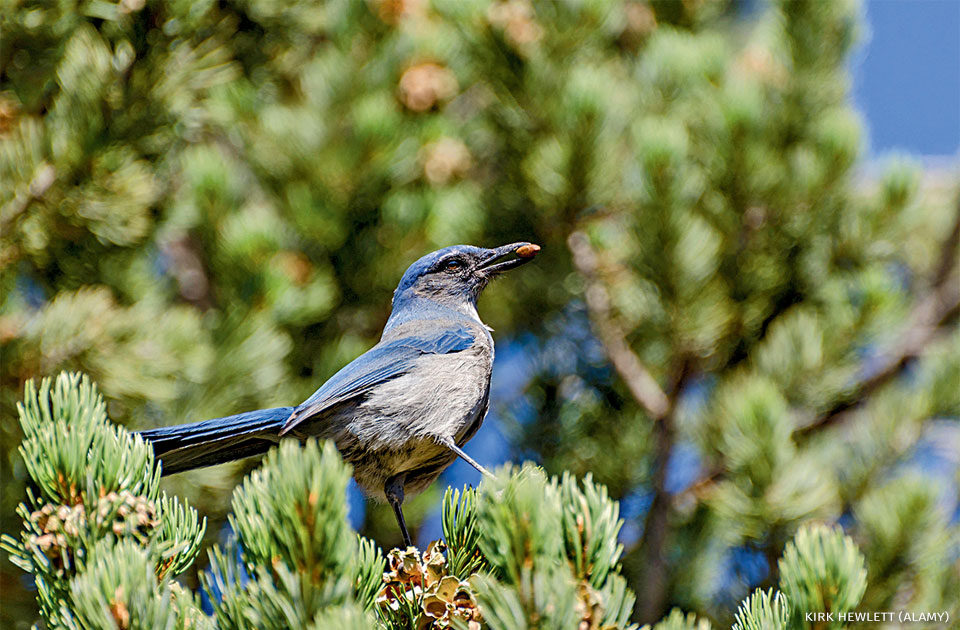
Woodhouse’s scrub-jays in New Mexico avoid habitats disturbed by the noise of gas well compressors and stay away even after those sounds are gone. The birds’ absence results in a decline of new pinyon pines, whose seeds are dispersed by the jays.
Attempts to adapt
For animals that stay in noisy areas, some try to adapt. They include certain bird species where studies have shown that individuals either sing more loudly in noisy areas or sing at times when there’s less human racket. In Bogotá, Colombia, for instance, scientists have observed that rufous-collared sparrows in noisy parts of town begin their dawn chorus up to 90 minutes sooner than birds in quieter areas so they can hear each other before morning traffic.
At the other extreme, some noise-impacted species may give up trying to communicate. In Portugal’s Tagus Estuary, the males of Lusitanian toadfish make nests and attract females to lay eggs in them with a loud, low-frequency sound dubbed the boatwhistle. But when marine biologist Manuel Vieira of the University of Lisbon and his colleagues played boat noise near the fish, the males didn’t sing as frequently and hence didn’t attract as many females as males in quiet areas, they reported in 2022 in Science of the Total Environment. Because of this—and the possibility that females avoided the noisy areas—males were more likely to end up with empty nests. “There are clear effects on the individuals and on their ability to reproduce,” Vieira says.
Noise also can interfere with an animal’s ability to respond to important sounds from other species. In a private game reserve near South Africa’s Kruger National Park, biologist Amy Morris-Drake of the University of Bristol in the United Kingdom has observed that dwarf mongooses eavesdrop on species like tree squirrels that sound alarm calls when they see eagle predators circling above. Hearing the squirrel’s alarm calls causes mongooses to flee immediately for cover, she says. But when she and her colleagues played road traffic noise, the mongooses instead froze, standing still and scanning their surroundings, according to a study they published in 2017 in Environmental Pollution. “That could not be a great response if a bird of prey was about to come flying down and try and nab a mongoose,” Morris-Drake says.
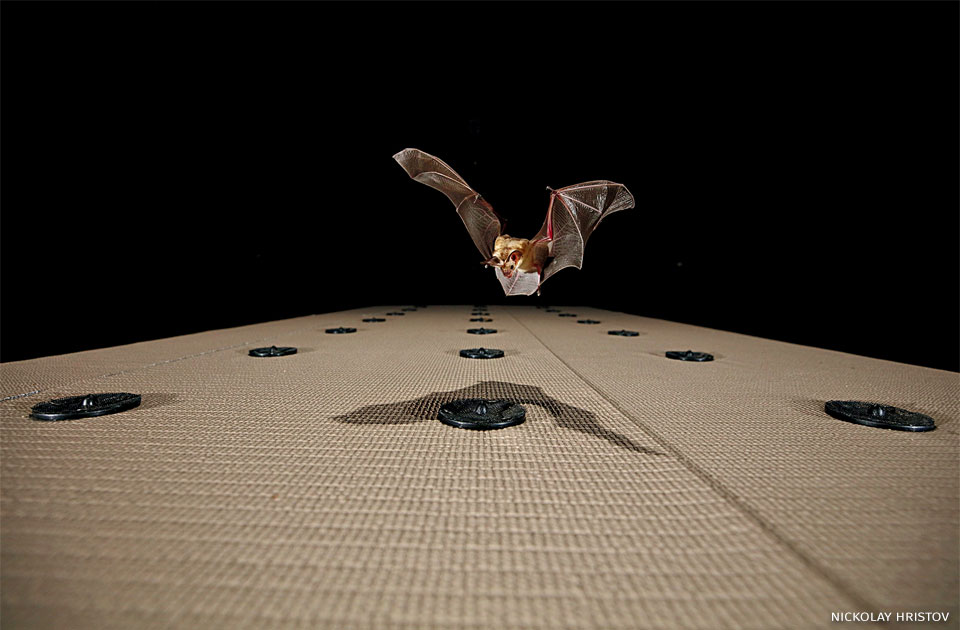
Bats in a laboratory experiment had trouble locating the sound of their insect prey when researchers broadcast white noise that distracted the animals from their task.
Noise and stress
Given their well-known reliance on sound to navigate, communicate and find food, bats, not surprisingly, are impacted by noise interference. Barber found evidence for such impacts in a laboratory study, published in Proceedings of the Royal Society B: Biological Sciences in 2021, where he and his colleagues trained pallid bats to follow the soft sounds of an insect’s footsteps. When the animals landed on a speaker playing a recording of this sound, they were rewarded with a mealworm treat. If white noise simultaneously was broadcast, however: “It was making the process of finding the [sound] harder. It took them longer to do it. They weren’t quite as good at it,” Barber says. That was the case even when the white noise was at a different pitch than the insect sounds, and the bats should have been able to hear the recordings. The finding suggests it’s not that the noise overpowers the insect sounds but distracts the bats, making them less able to focus on finding food. Barber likens the effect to a person at a cocktail party who is unable to focus on a friend talking because of other conversations nearby.
Beyond interfering with essential behaviors such as navigating, foraging and finding mates, human noise also causes stress. Some field studies even have reported that birds living in noisy areas have abnormal levels of the stress-triggering hormone corticosterone in their blood. Stress can have pernicious effects on an animal’s body, behavior and ability to reproduce. Vieira suspects it’s why male toadfish that did manage to attract females in noisy waters had relatively few surviving eggs; the father fish may have been too stressed to properly care for their offspring by cleaning the eggs and moving around to boost water flow.
Stress can be especially harmful for young animals, says ornithologist Henrik Brumm at Germany’s Max Planck Institute for Biological Intelligence. In a study published in 2021 in Science Advances, he and his colleagues raised zebra finch chicks in the presence of traffic noise. Blood analyses showed that the chicks had more molecular signs of stress, as well as poorer immune responses, than chicks raised in quiet environments. “We know this from humans: When you’re stressed, you’re more prone to get a cold or disease,” Brumm says. And possibly because of stress, the noise-exposed chicks didn’t learn to sing properly from their parents—a challenge that could make their lives as adults harder. “They made mistakes when learning the songs, and it took them a much longer time to develop the song,” Brumm recalls.
Noise might be so stressful it could contribute to injury or death. Wildlife physiologist Terrie Williams of the University of California, Santa Cruz, posits that loud noises from human activity in the oceans may be one reason behind some mass strandings of whales. The mechanism could have something to do with how stress disrupts the animals’ diving response.
In a study published in 2022 in Functional Ecology, she and her colleagues worked with Indigenous hunters in Greenland to capture 13 narwhals and tag them with a heart rate monitor before release. The researchers wanted to understand how seismic air gun blasts produced by a ship—the kind emitted while exploring the ocean floor for fossil fuels—would affect the mammals.
For the two narwhals within hearing distance of the blasts, the animals swam faster to try and escape the noise, while their heart rates dropped precipitously, down to just three beats per minute. That’s far less than the 20 beats per minute usually seen when the animals glide down into the ocean’s depths, leading Williams to suspect a kind of freeze response due to fear. She worries that this response, combined with energetic diving movements, could set the animals up for heart- and circulation-related problems.
While her hypothesis remains unproven, it raises questions about how animals deal with rapidly growing human racket. “They all have unique vulnerabilities as a result of … millions and millions of years of evolution, so they can’t adapt fast enough,” Williams says. At the very least, she says that noise impacts on wildlife should be taken into consideration when planning new noise-generating activities, from fossil fuel exploration to creating new shipping lanes.
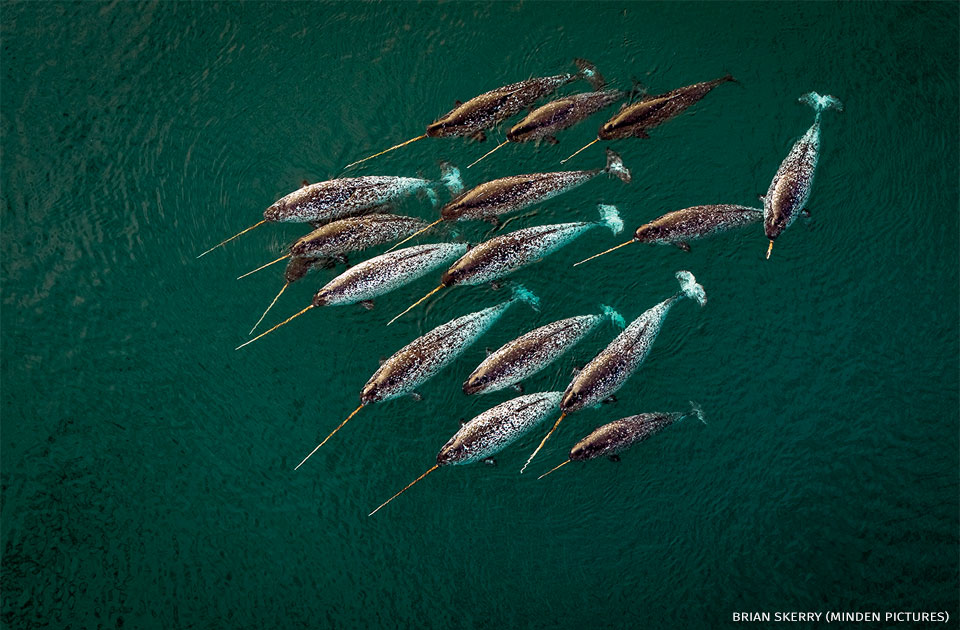
Narwhals are so disturbed by loud noise that their heart rates drop dangerously low, threatening the animals’ health and survival.
Searching for solutions
Some policymakers have begun to act. In the United States, Phillips says she’s seen natural resource managers increasingly take note of noise impacts on wildlife. The National Park Service, for instance, has been monitoring noise levels in parks, using quieter equipment for park maintenance and working with nearby airports to limit aircraft noise. Meanwhile, nonprofits such as Quiet Parks International have been working to identify and preserve quiet wilderness and conservation areas.
Technological solutions also may help. Research is underway to develop quieter boat propellers and plane engines, while the growing popularity of electric cars is predicted to reduce noise from road traffic. In parts of Europe, some highways already are built with noise-dampening “quiet asphalt,” which typically contains minute holes in its surface to absorb sound, reducing noise from vehicle tires. And on the continent’s northern shores, engineers are creating “bubble curtains” in water around some wind farm construction sites to muffle noise that might harm harbor porpoises and other marine creatures. The curtains work by pumping air through hole-studded hoses along the seabed to create a noise-dampening wall of upwelling bubbles.
Even setting speed limits on road traffic and ships can make a difference. Some authorities, such as the Vancouver Fraser Port Authority, now encourage commercial ships to slow down while traversing certain waters inhabited by endangered southern resident orcas. Examples such as this show that where there’s political will—and, in some cases, funding—it’s possible to reduce noise impacts on wildlife, Brumm says.
He and other scientists point out that making the world quieter isn’t just good for wildlife but also for people. In a study published in 2020 in People and Nature, Barber and his colleagues observed how visitors to the redwood-studded Muir Woods National Monument outside San Francisco responded to weekly quiet periods where they were instructed to limit noise, talk quietly and silence their cell phones. As a result, he says, people saw more birds, because the animals had moved closer to the trails, and reported having a better overall experience in the park. “It shows you that people and wildlife have the same goals often. When we’re in nature and trying to experience it, we want it to be quiet, too,” Barber says.
It will take a concerted effort from policymakers, civil engineers, industries and others to reduce noise pollution where it exists and preserve the quiet natural places that remain. That includes Feridhoo Island in the Maldives. Though it suffers from the occasional roar of boats during mornings and evenings, it’s generally much quieter than more urbanized islands nearby. Beggiato hopes that it will stay that way, and that the fish that have returned there will stay long after the recordings have stopped. Hopefully, they’ll begin to compose their own raucous symphony of crackles, chirrups, thumps and grunts—and by restoring nature’s music, help restore nature itself.
Katarina Zimmer is a science and environmental journalist who is based in Berlin.
More from National Wildlife magazine and the National Wildlife Federation:
More data centers, more environmental problems? »
Birds Coping with Chronic Clamor »
How Light Pollution Impacts Wildlife & How You Can Help »