Why We Need Peatlands
With significant carbon storage capabilities, peatlands are an unheralded but powerful ally in the fight against climate change
- By Lance Frazer
- Conservation
- Sep 24, 2025
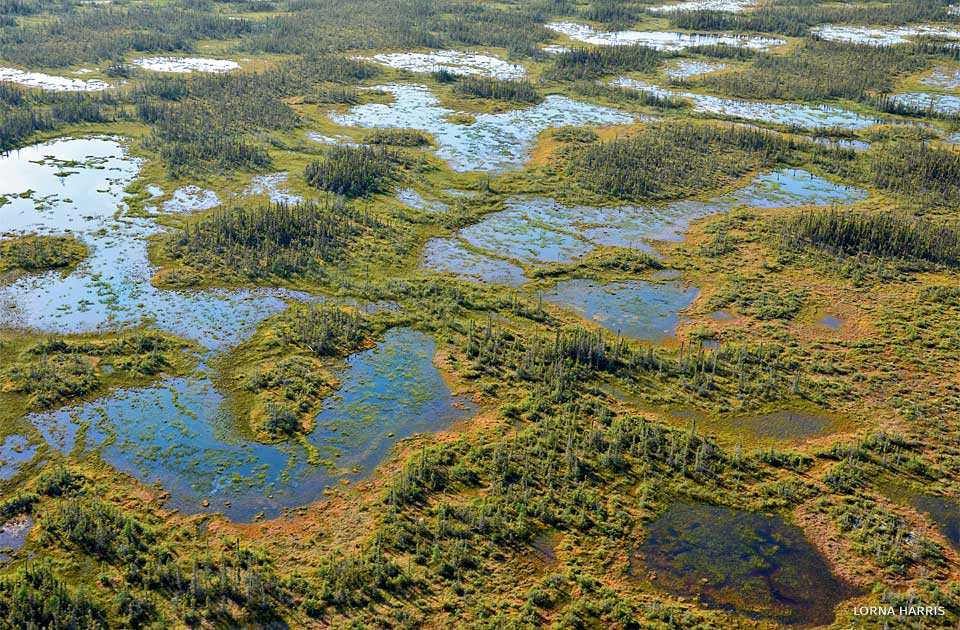
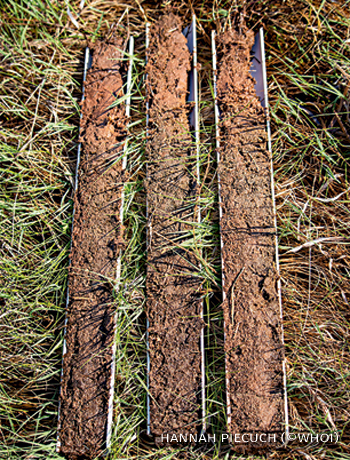
Canada’s Hudson Bay Lowlands (above) are North America’s largest peatland. These ecosystems’ deep organic soils (below) can store vast amounts of carbon for thousands of years.
AT FIRST GLANCE, northern Canada’s vast Hudson Bay Lowlands may appear to be a wasteland, stretching flat and unbroken to the horizon in all directions. Yet this roughly 124,000-square-mile wetland brims with an astounding diversity of wildlife—from polar bears, wolverines and caribou to hundreds of species of migratory birds, including red knots, Hudsonian godwits and other shorebirds that breed or fuel up here before traveling thousands of miles to South America for the winter. Indigenous Peoples have called these same pond-studded lowlands home for millennia.
The Hudson Bay Lowlands are vital for another reason. Blanketed by soggy peat soils, they make up “the largest peat complex in North America and the second largest in the world,” says Adam Kirkwood, a research associate for Wildlife Conservation Society Canada. Age-old ecosystems that cover millions of square miles from the Arctic to the tropics, peatlands play a key role in mitigating climate change. Thanks to the wetlands’ constantly saturated conditions, dead leaves, roots, stems and other plant materials decompose very slowly—over hundreds to thousands of years—and accumulate as deep, organic soil that traps carbon in the ground rather than releasing it to the atmosphere as planet-warming carbon dioxide.
In a peatland, Kirkwood explains, a lot of vegetation may grow, “but as it dies, it doesn’t decompose quickly. This peat can go back 10,000 years, which means the sequestration of massive amounts of carbon that just sits there.” Canada’s peatlands alone store an estimated 150 billion metric tons of carbon in their soil, he adds, equivalent to 11 years of global industrial emissions.
Known as bogs, fens, swamps or other names depending on their type, peatlands cover just 3 percent of Earth’s surface. Yet together they contain 550 billion metric tons of carbon—more than the amount stored in all global forests combined, including the tropical rain forests that often are touted as our most promising nature-based solution to climate change.
Despite their importance, peatlands remain little-known ecosystems whose value often goes unrecognized. According to a global analysis published in the journal Conservation Letters in February 2025, just 17 percent of the world’s peatlands fall within protected areas—considerably less than other “high-value ecosystems” such as mangroves (42 percent) and tropical forests (38 percent). “Our research reveals that these vital ecosystems don’t have anywhere near the level of protection they need,” says Kemen Austin of The Nature Conservancy, lead author of the study.
The study also concludes that nearly a quarter of all peatlands are impacted by human encroachment: drained, burned or otherwise degraded for commercial agriculture, forestry, road building, mining and other development. In addition, peat is extracted for its use as a fuel and as a soil amendment in both horticulture and agriculture. In Canada, Kirkwood says valuable peatlands in the Hudson Bay Lowlands are threatened by a large controversial mining project. The region is rich in nickel, chromite, palladium, platinum and other metals important in digital technology and renewable energy development.
If these peatlands are disturbed, he says, they could release more than 2 billion metric tons of carbon dioxide. According to the Conservation Letters study, up to 2.5 billion metric tons of greenhouse gases already are emitted worldwide each year by damaging or destroying peatlands. Kirkwood, Austin and other peatlands scientists stress that it’s critical to prevent further transformation of carbon-storing peatlands into carbon sources by protecting and, whenever possible, restoring them.
Some peatlands can be brought back to life. As an example, consider Dutch Slough, a tidal marsh in the heart of California’s Sacramento–San Joaquin Delta, “one of the world’s most human-modified areas; nothing is not changed by humans,” says Jason Riggio, a University of California, Davis, assistant project scientist who studies the delta’s wildlife.
Once a vast freshwater marsh dominated by a kind of bulrush called tule that thrived in rich peat soils, the marsh was drained for commercial agriculture and other development beginning in the late 1800s. To provide water to Southern California, levees were constructed to funnel southward new sources of freshwater that otherwise would flow in from the rivers at high tide. By the 1930s, just 5 percent of Dutch Slough’s original 350,000 acres of marshland remained.
Then in 2003, the California Department of Water Resources purchased a 1,187-acre parcel of the marsh that had been slated for construction of about 5,000 new houses. Fifteen years later, workers began grading a portion of the land—smoothing out the steep hills and deep gullies that were byproducts of draining and development. Once grading was complete the following year, department staff, in collaboration with the nonprofit River Partners, planted 25,000 tule plugs and 50,000 shrubs and trees to restore native marsh vegetation. After a year and a half of plant growth, the team breached the levee in several locations, allowing freshwater to begin flowing in and out with daily tides, as it had historically.
Already, restored parcels of the wetland are providing habitat for native species, including Chinook salmon, steelhead, western pond turtles and least bitterns. And although the enormous amount of carbon that has been lost from the destroyed delta cannot be recovered for hundreds to thousands of years, restored marsh areas are capturing and storing carbon in their peat soils today.
“We’ve found that the land can be restored,” says Riggio. “It doesn’t matter how degraded or modified it is. There are areas like Dutch Slough that were modified and used for more than 100 years, and now, after just two to three years of work, they’re returning to what they were.”
If more of the world’s peatlands can be restored—or protected, if they remain intact—“they will continue to pull carbon dioxide out of the atmosphere and store it as organic carbon in the soil,” says Meredith Cornett, who manages a new peatland protection and restoration project for the Minnesota Department of Natural Resources. “Peatlands can be a powerful climate ally, provided we can protect them,” she says. “To swerve from peatlands as a carbon sink to a [carbon] source would be a dire moment for people, nature and the world we all live in.”
Lance Frazer is a California-based writer who focuses on science, nature and the environment.
More from National Wildlife magazine and the National Wildlife Federation:
Our Work: Protecting Our Waters »
How Healthy Soil Can Help Save the Planet »
Less Than Half of All Carbon-Storing Grasslands Remain »