Flying Wildlife-Friendly Skies
Airport wildlife biologists work to prevent plane–animal collisions nationwide
- By Joliene Adams
- Conservation
- Sep 23, 2026
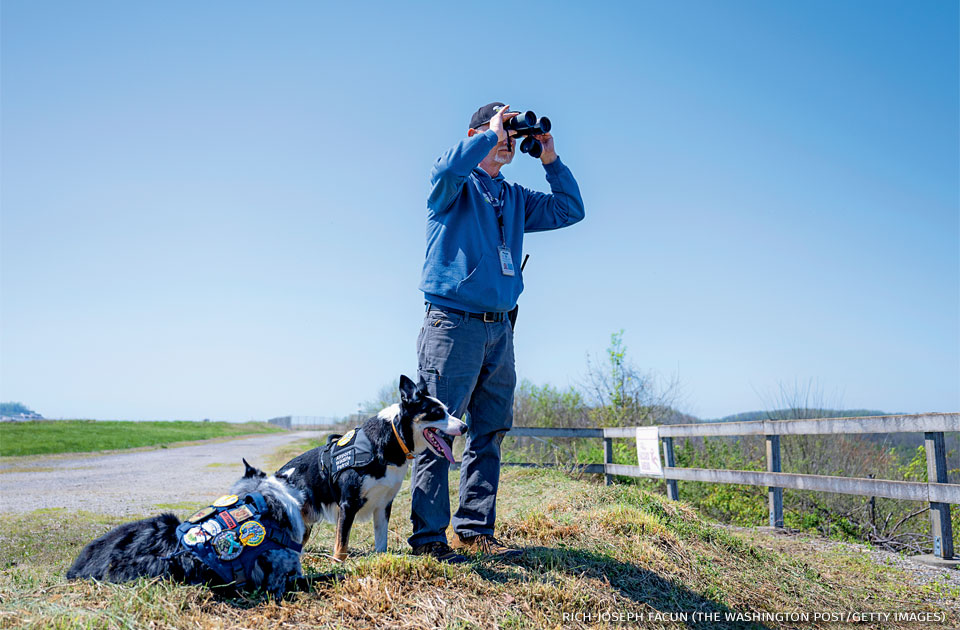
Wildlife specialist Chris Keyser (above) scans the area around Yeager Airport, in West Virginia, with dogs Hercules, on the left, and Ned at the ready. A flock of double-crested cormorants (below) flies past JFK in New York.
FOR ALEX BLANCHARD, head of the wildlife management program at Salt Lake City International Airport, expecting the unexpected is part of her job.
Take earlier this year. A red fox on the airfield isn’t especially unusual, but this one’s behavior was. Upon approaching, Blanchard and her team discovered why: A coyote, believed to be pregnant, was attacking the fox, prompting a fight for survival on the tarmac. The team corralled the animals separately—without disrupting flights—before safely guiding the fox toward a shuttered golf course and the coyote toward neighboring wetlands.
“We’re sort of working in the middle of hazards,” says Blanchard of the airport’s location between agricultural fields, hunting clubs, landfills and a 900-acre wetland.
While the Federal Aviation Administration (FAA) does not require every airport to employ a biologist like Blanchard, the agency does mandate that commercial airfields perform risk assessments and issue management plans when problems arise. And those problems are rising. The latest Wildlife Strike Report—put out by the FAA and the U.S. Department of Agriculture, covering 1990 to 2024—identified 2024 as having the most reported incidents ever, at 22,372. Industry experts attribute that growth to factors including ever-expanding development around airports, increased air traffic and quieter engines that make it harder for wildlife to detect approaching aircraft.
“The first time I toured Dulles Airport, I watched a duty manager race down the runway at 80 mph, scanning for debris” including wildlife, says Laura Francoeur, chief wildlife biologist at the Port Authority of New York and New Jersey. As she saw the manager “stopping and starting to clear hazards just in time” before incoming flights, she says, “I remember thinking, This is a high-paced job.”
John Weller of the FAA calls the role of airport wildlife biologist a “specialty within a specialty.” In practice, the job is part action sequence, part fieldwork and part desk sludge. One moment: skilled falconry to scare off birds. The next: sitting at the computer, logging strike data.
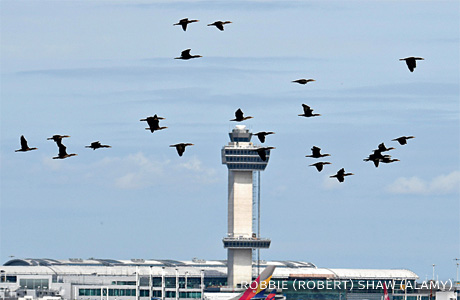
In the 121 years since Orville Wright reported the first known avian–aviation collision, bird strikes remain the most common wildlife hazard for planes. The FAA established the Wildlife Strike Database in the 1990s to standardize reporting across airports nationwide.
“Strikes are rare events, but they happen every day,” Weller says. “With about 60 strikes daily in the U.S. ... the odds are about 1 in 1,000.” The risk of a human fatality from a bird–plane strike is far lower, or below 0.1 percent, according to AVweb. At stake beyond lives: multimillion-dollar aircraft, delays and airport reputations.
While doves, pigeons and European starlings show up near most runways, airport zoology can be hyperlocal. New York’s John F. Kennedy International (JFK) is likely the only U.S. airport with a significant population of seasonal diamondback terrapins. The turtles feed and mate in adjacent JoCo Marsh before traveling farther afield in June and July to lay their eggs. Last year was JFK’s busiest year yet, with 1,581 terrapin encounters. The wildlife team sets up barriers to redirect turtles away from runways, capturing and relocating them when needed, and studies the reptiles’ long-term behavior through tagging and sometimes GPS tracking.
Yeager Airport’s hilltop location in West Virginia means it doesn’t see low-elevation turtles. But it might be the only U.S. airport currently employing border collies to deter birds. Hercules and Ned are “herding dogs,” says the airport’s Paige Withrow. “They have the chase instinct, not the kill instinct.” Since they joined the wildlife management team in 2018 and 2024, bird strikes have dropped 70 percent.
In addressing wildlife around airfields, the first line of defense is prevention. “An airport is not a park,” Weller says. “It’s not a wildlife refuge. It exists for safe travel.” To dissuade wildlife from taking up residence, managers reduce potential resources, such as food, water and shelter. Typical mitigation tactics include putting up perimeter fencing around would-be habitat and installing antiperching spikes, limiting vegetation, laying netting or wire grids over ponds, and covering culverts and drains.
When those efforts don’t work, managers may look to nonlethal deterrence, such as pyrotechnics, lasers and other methods. Recent inventive approaches include taxidermy coyotes on swinging platforms that mimic live predators’ movements and Aurora, a robot dog introduced to Alaska’s Fairbanks International Airport in 2024. Meanwhile, scientists studying bird vision at Purdue University are collaborating with the National Wildlife Research Center, a federal institution, to develop aircraft lighting that improves visibility, giving birds more time to avoid collisions.
When possible, safely sharing habitat remains a goal. At Jackson Hole Airport in Wyoming, biologists established food sources outside airport boundaries and have used dancing animatronic birds to lure greater sage-grouse away from runways. “They literally just convinced the birds to get off the airport and move farther away,” Weller says.
The work will continue to evolve as the climate changes. At coastal hubs like JFK, “sea level rise has definitely become an issue,” says Francoeur, noting that higher tides occasionally have submerged barriers meant to protect terrapins and tarmacs alike.
A 2022 article in The Aeronautical Journal reports that flight routes and safety guidance rely on known bird behavior, even as climate change is altering bird population distributions and migration patterns. In a 2018 policy brief, the Airports Council International declared that airfields must factor climate-related wildlife shifts into future planning.
Even increased rainfall can lead to problems. “Rain brings a lot of insects and worms, which brings more birds,” Withrow says.
“You can have puddling on runways and taxiways, and suddenly you’ve created habitat,” Weller adds. Weather pattern changes can mean more or new vegetation, which in turn can attract new species of wildlife, as well as more old familiars.
One thing that won’t change? Our need to share habitat. Of Jackson Hole’s sage-grouse efforts, “That’s the coexistence I’m always hoping for,” Weller says.
Joliene Adams is a writer based in the Pacific Northwest.
More from National Wildlife magazine and the National Wildlife Federation:
Why Did the Northern Red-Legged Frog Cross the Road? »
Conservation Dogs, Nature’s Best Friends »
Deadly Crossings »