Who You Gonna Call? The Beaver Hotline, of Course.
When Montana beavers and landowners hit a logjam, NWF’s beaver conflict resolution team goes to work
- By Katie Hill
- Conservation
- Sep 23, 2026
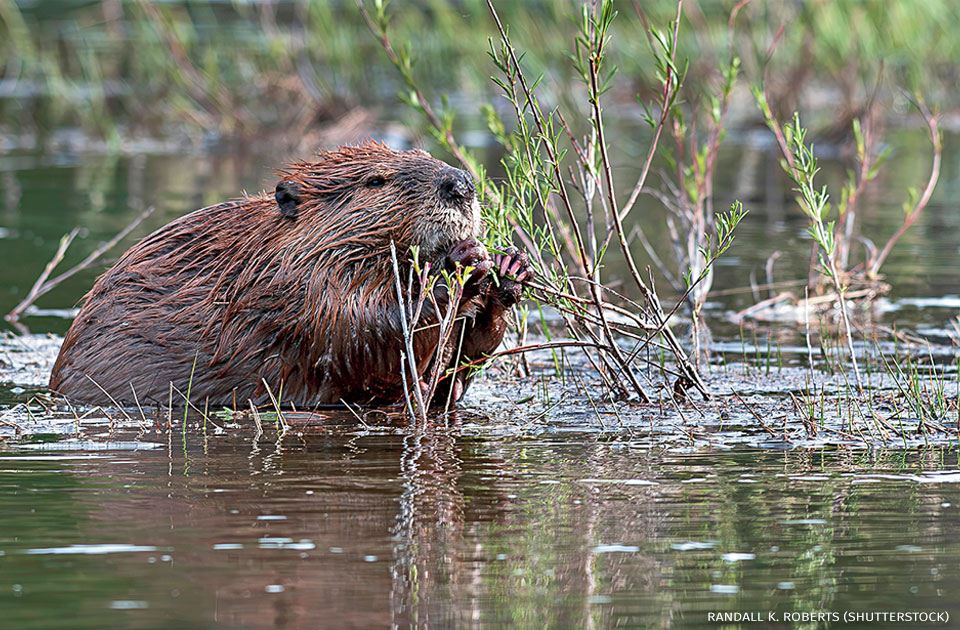
The beaver (above) is the largest rodent native to North America.
UNDER THE GLARE OF SPRING SUNSHINE, Tanner Clegg wades hip-deep into Ross Fork Creek on Gaugler Angus Ranch near Garneill, Montana. Plunging a rake into a culvert, he dislodges a pile of branches and debris then hoists the sludge onto the bank, not far from where Mark Gaugler, the owner of the ranch with his wife, Laurie, watches. As Clegg, a seasonal habitat technician with the National Wildlife Federation, goes back for more, Gaugler recalls a time when he waded the same spot to remove the blockage by hand.
“My head was the only thing above water, the culvert was so plugged,” Gaugler says, chuckling.
It’s the middle of April. To the east, the Big Snowy Mountains hardly can be described as snowy. To the west, the Little Belt Mountains are bare. Following one of the warmest, least snowy winters on record, private landowners and public land managers across the region bear mounting pressure to keep water on the landscape as long as possible.
Beavers know how that feels. The native, semiaquatic rodents are masters at preserving water, especially in fall, when their dam-building activity peaks. On some parts of his ranch, Gaugler is happy for dams to hold water. But this particular culvert is meant to keep water moving under a road, leaving the route above passable. When beavers’ plans collide with landowners’ priorities, discord can ensue.
That’s where NWF’s Beaver Conflict Resolution Program steps in. Of the few dozen people present at this April workday, all share the same goal: to keep the peace between the Gauglers and the beavers that live and dam on their land.

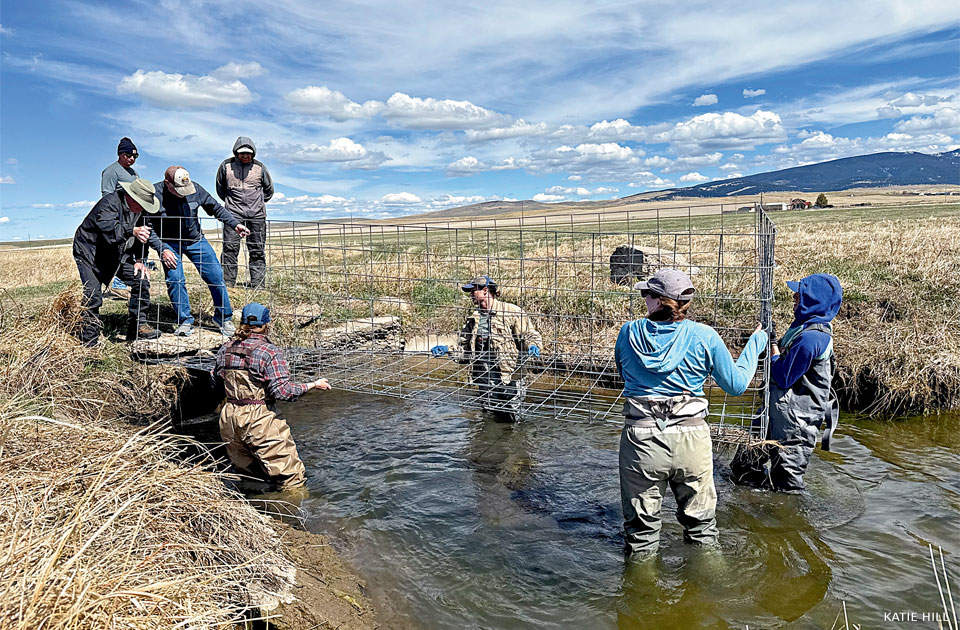
A group lowers an exclusion fence into Ross Fork Creek on Gaugler Angus Ranch in April.
Straight from the source
Beavers in North America likely totaled between 60 and 400 million before trapping ramped up in the 18th century. Today the number is closer to 12 million, with precipitous losses stabilized over the past two decades thanks to public education on how beaver dams benefit wetland ecosystems.
In 2019, NWF and the Clark Fork Coalition, a watershed group from western Montana, launched a pilot beaver conflict mitigation program in partnership with Defenders of Wildlife. NWF took over management of the program in 2024. “These groups recognized the benefits of having beavers in the watersheds, but the only means of addressing conflicts was to lethally remove them,” says Elissa Chott, who has led the program since its inception. (Beaver relocation isn’t illegal in Montana, but the process is challenging.) “We needed a nonlethal way [for landowners] to mitigate the impacts.”
Negative impacts range from clogging water flow through culverts, as on the Gauglers’ ranch, to causing flooding in inconvenient places like pastures to felling trees that provide shade and stabilize creek banks. Solutions include installing exclusion fences that keep beavers from damming culverts and wrapping trees to protect them, as well as pond leveling systems that release water to prevent overflowing. Chott also developed education and outreach materials, and eventually landowners with problem beavers—or at least those who wanted to keep the beavers alive—heard about the initiative and asked for help.
Word spread. Additional technicians in other parts of Montana followed, and under NWF’s guidance, the program expanded northeast to Great Falls, southeast to Bozeman and north to Kalispell. Early adopters proved something relatively new in modern wetland resource management: Nonlethal beaver conflict reduction is possible.
“There was a lot of wariness about these methods,” Chott says. “Nobody had ever done them on a wide scale” in Montana, and local DIY efforts—where a fence wasn’t big enough for a culvert, say—had failed. But the team showed that, “yes, these things can work, as long as they’re built correctly.” Similar programs now exist in Washington, Oregon, Virginia, Colorado and elsewhere.
Hotline brrrring
Today when Montana Fish, Wildlife & Parks gets a call from a private landowner or a public land manager about a problem beaver and determines that nonlethal means are appropriate, the state passes the caller along to NWF—a collaboration that Shelby Weigand, NWF’s riparian connectivity manager, calls “a huge success.” While many human–beaver conflicts still go unreported and beaver population estimates are inexact, the volume of projects the team has tackled since 2019 speaks for itself: 121.
Calls grew so frequent, the team now operates the Montana Beaver Conflict Resolution Hotline (406-393-5557). If you live, ranch or vacation in Montana, Weigand suggests saving the number to your contacts. The call is free, and cost-share options for materials and other expenses help reduce the financial burden on landowners.
“We have built tolerance, and that feels like success,” says Weigand, who also helps co-manage the Montana Beaver Working Group, a collaborative effort that is revising the state’s Beaver Action Plan and, in addition to NWF, is made up of some of the government agencies, conservation nonprofits and sporting groups present in April at the Gauglers’ ranch. “There’s so much hope.”
As volunteers clamp pieces of the exclusion fence into place and lower the contraption into the water, Gaugler looks on from the safety of the bank. He’s excited to see where else—if not inside the culvert—the beavers might go to work. After all, as he shared with the volunteers upon their arrival, beavers have become his favorite hobby.
“Talking beavers is like talking politics or religion. You either like them or you don’t,” he says. “But we sure do.”
Journalist Katie Hill is based in Missoula, Montana.
More from National Wildlife magazine and the National Wildlife Federation:
Nature's Ecosystem Engineers »
Beavers as Ecopartners »
Wading in Water, Sharing Common Ground: Conservation Lessons from Beavers »