Looking for a Career? Have You Considered Tree Care?
We need trees. Trees need tending. So what happens when arborists are in short supply?
- By Delaney McPherson
- Conservation
- Sep 23, 2026
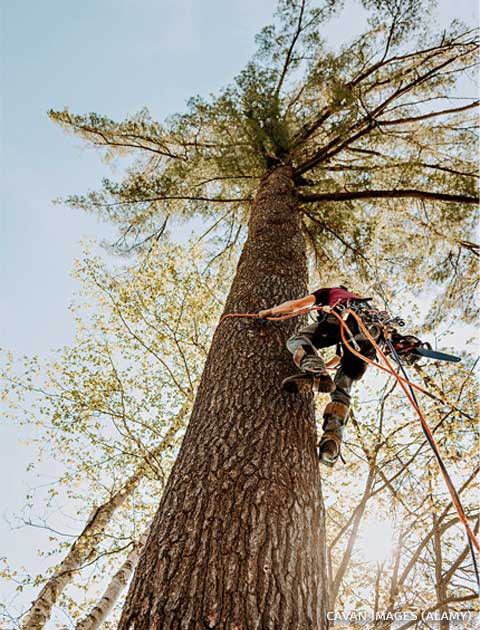
Climbing trees is just one piece of a career in arboriculture. Many other parts of the work take place on the ground.
WHEN I FIRST MET CHARLES BOSTON in October 2023 in Washington, D.C.’s Garfield Park, he was photographing a tree that had died. According to Boston, a certified arborist and chief programs officer at Youth Arboriculture Career Experience, the sapling had been planted recently—likely by the city’s Urban Forestry Division—but when no one maintained it, it failed to thrive. For Boston, this was a teachable moment he could use to illustrate to his students how important careers in arboriculture can be.
“It’s more than planting a tree in the ground. A tree is a living organism,” he says. “It’s really no different than a pet or a child. It needs constant monitoring when it’s young and establishing roots.”
That’s a big problem for an aging but essential field of professionals who range from tree climbers and trimmers to safety coordinators, plant health care technicians and researchers who test soil, study forestry best practices and inoculate trees against ailments such as Dutch elm disease. According to the U.S. Department of Education, for every five skilled laborers who retire from the nation’s general workforce, only two fill their shoes. While there’s no central source in the United States for tracking arborist-specific numbers, the shortage is a known fact in arboriculture circles.
“I called a couple of members in Austin [Texas] and Cambridge [Massachusetts] and asked from their vantage, ‘Is there an arborist shortage?’ ” says Leslie Berckes, executive director of the Urban and Community Forestry Society, a nonprofit with 2,000 members. “They feel there is, which can ultimately slow down city work.” According to the latest Green Industry Benchmark Report—which polled more than 380 landscaping business owners, including arborists, in 2021—71 percent of those surveyed reported difficulty finding skilled labor. In addition to working for landscaping companies, arborists can be employed by states and municipalities, homeowners, arboretums and botanical gardens, universities and more.
To some, the deficit is no surprise. “This has been an issue in our industry for 87 years,” says David White, president and CEO of the 1,400-member Tree Care Industry Association (TCIA), referencing his organization’s founding in 1938. “Consistently we’re asking: How do we get more people involved?”
While the need for skilled workers isn’t new, rapid urbanization is making us increasingly dependent on urban trees. The Environmental Protection Agency reports that increased tree coverage can lead to cleaner air, cooler cities and higher rates of carbon sequestration. But trees must be healthy—sited appropriately, with adequate sunlight, water and soil when planted, and with regular maintenance and inspection after planting—to deliver maximum benefits. Many cities have goals for increasing canopy coverage, but if there isn’t a workforce to service those trees, the likelihood of survival to full maturity is low. According to the Journal of the American Planning Association, one in three urban trees planted will die within five years due to under-resourcing. All of that requires a steady workforce. While there’s no straightforward reason why it’s difficult to recruit fresh talent, some say negative perception plays a role.
“It’s seen as entry-level, low-skill work, when it’s not that at all,” Berckes says. “It’s highly technical work.”
Others say arboriculture isn’t presented to enough young people as a viable profession. Boston’s Youth Arboriculture Career Experience is trying to change that by teaching middle and high schoolers in D.C. the ropes of being an arborist, from how to safely rig themselves up and climb a trunk to identifying signs of tree illness.
“Where are the apprenticeship programs? Where are the companies looking to hire students now that can train on the job?” says Boston, who urges students to ask these types of questions at the career fairs he often attends. “Young people need to be given options to make a sound decision.”
His and similar programs aim to show youth that, while some pathways in the field call for an advanced degree, others provide on-the-job training as a way up the ladder. As a boost, aspiring workers can seek certifications from the International Society of Arboriculture (ISA). Professional certification requires either at least three years of full-time experience or education in a related field, plus passing a skills and safety exam.
“It’s a good way to show a future employer or possible customer that you are following a code of ethics, and once earned, it can equate to a higher pay grade,” says Caitlyn Pollihan, CEO and executive director of ISA. “You can have a long-term, family-sustaining-wage career.”
Even so, a lack of job security continues to plague the trade. One example of this: In 2022, the Inflation Reduction Act directed $1.5 billion to urban forestry, helping create and maintain arborist jobs. But when in 2025 the Department of Government Efficiency voided funds, including a $75 million grant that created jobs, many positions evaporated. Coupled with the seasonal nature of some work, economic instability can feed the belief that an arboriculture career isn’t sustainable, but tree care is a year-round effort, says White.
For him, addressing negative impressions and replenishing the workforce is a top priority. In May 2026, TCIA formed a task force to brainstorm ways to reach young people and expand recruitment, including new apprenticeship programs.
“We’re getting better at articulating that this is not a dead-end career. There are opportunities for advancement and opportunities without a two- or four-year college program,” White says. “There is a diversity of careers available in what seems like a straightforward industry. You have to be part biologist, part engineer and part artist.”
Delaney McPherson is associate editor of National Wildlife.
More from National Wildlife magazine and the National Wildlife Federation:
Urban Orchards Bear Fruit for All »
Want to Nurture Wildlife? Plant a Native Oak. »
A Plea for Trees »