A Harvest That Was a Whale of a Long Time Coming
The Confederated Tribes of Siletz Indians are reclaiming their ancestral natural resources, beginning with the harvest of a stranded whale carcass
- By Michael Rohm
- Conservation
- Sep 23, 2026
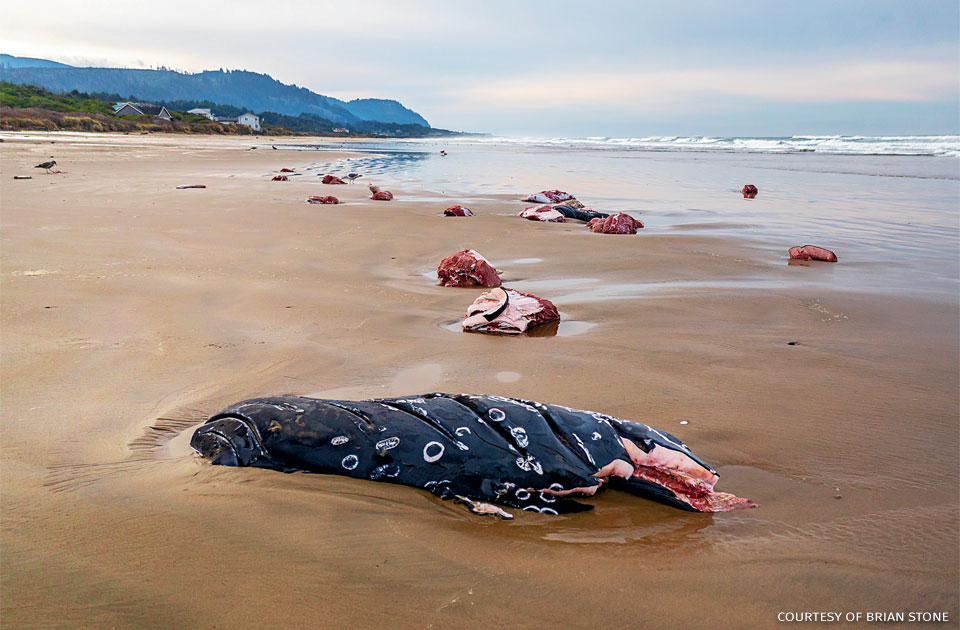
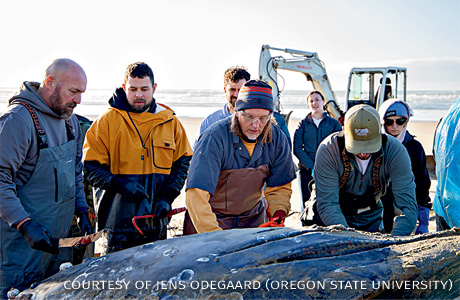
Remains of a juvenile humpback (above) dot the beach in Oregon last fall. Siletz members and the necropsy team (below) harvest parts for Tribal use and samples for testing.
ON NOVEMBER 15, 2025, a juvenile humpback whale was discovered alive and stranded in shallow water just outside the small town of Yachats, on Oregon’s central coast. Within 24 hours, the Oregon Marine Mammal Stranding Network had coordinated a coalition of veterinarians; first responders; authorities from Oregon State Parks, state police, the Oregon Department of Fish and Wildlife—and, for the first time, the Confederated Tribes of Siletz Indians.
While the Siletz have lived in the region for thousands of years, federal policies of the last century and a half restricted many activities central to Tribal subsistence and identity, including fishing, hunting, foraging and harvesting. That changed after a policy shift last year, with the Siletz present for decisions regarding the November whale stranding.
When efforts over several tidal cycles to refloat the whale had failed, it was sedated and euthanized. The carcass was made available to the Siletz, who use whale bones, blubber and baleen for tools, utensils, oil and regalia.
“I get goosebumps when I think about what happened,” says Lisa Norton, the Tribe’s chief administrative officer. “We fell right into our culture—not this ‘woo woo’ Native America spirituality thing but the essence of who we are.”
For much of its history, the U.S. government dismantled Indigenous ties to the land. But in 2023, Congress passed the Siletz Reservation Act amendment, creating a legal route to renegotiate Siletz rights with the state of Oregon. And in 2025, the Oregon Fish and Wildlife Commission rescinded a consent decree restricting Tribal access to natural resources—a 1980 compromise the Siletz had been forced to make to reclaim a fraction of their ancestral homeland.
“Our culture is largely based on our natural resources,” says Angela Sondenaa, the Tribe’s natural resources director and a member. “It is derived from our lands, our homelands, the species we have interacted with since time began.”
Meghan Dugan of Oregon Fish and Wildlife says the consent decree was a product of its time, representing “a biased and distorted position on Tribal sovereignty.” The Confederated Tribes of Grand Ronde, whose headquarters is located northeast of present-day Siletz, remains the only group in the United States with a comparable consent decree, but “they are working through Congress on a similar solution,” Dugan says.
“Respecting sovereignty is not only a legal requirement,” says Karen Cogswell of the U.S. Fish and Wildlife Service. “It is central to ethical and sustainable fish and wildlife management.” Most harvest decisions today, she says, are coordinated among Indigenous groups, states and federal agencies via what are known as government-to-government relationships. These differ depending on region: In the Pacific Northwest, Indigenous Peoples have long harvested salmon, steelhead and elk; in the Plains, bison; and in what is now Alaska, caribou, moose and—under agreement with the National Oceanic and Atmospheric Administration (NOAA)—marine mammals.
Michael Milstein of NOAA Fisheries says the agency also maintains a relationship with the Siletz, among other Tribes, reflecting NOAA’s commitment “to respect Tribal traditions and ensure responsible resource management.”
“They recognize our rights as Indigenous people,” Sondenaa says. “NOAA does not tell us what our cultural and educational needs are. They support whatever that looks like for us.”
Usually beached whale carcasses in Oregon are buried, left to decompose, or—in one notorious incident in the 1970s—blown up with dynamite. The Yachats humpback went a different way. After a prayer and offering of tobacco, Tribal member Todd Logan led the harvest and assisted the on-site veterinary team in removing samples for a necropsy.
“I wanted to be mindful and respectful,” Logan says, “because through that data, we can get more information on how to be better stewards of our resources.” Although his only previous experience with a whale harvest was as an observer among the Iñupiat in Alaska, Logan drew on lifelong hunting and butchering skills. “Everybody thought we had done this before,” he says. “I believe because of us they were able to harvest more samples out of that creature.”
“I was really glad [Siletz members] were there,” says Kurt Williams of the Oregon Veterinary Diagnostic Laboratory. “From a practical standpoint, they were extremely helpful. But far more importantly, they really put this into context—just seeing the importance of these animals to everyone who cares about the oceans.”
By the time the team finished, the last remains ready to be stored on nearby Tribal ground, the sky was dark with the tide nipping at the ankles of those still on the beach. “The satisfaction of being able to respect this creature with love—I will carry that for the rest of my life,” Logan says.
So will Norton, whose son helped with the harvest alongside Logan. “This whole process has been one of rediscovering. While the whale is new, the process is very, very old,” she says. “The next generation won’t have to learn this. They will already know it.”
While Norton says the Yachats humpback was “the first time in living memory” the Siletz had been able to harvest a whale carcass, it would not be the last. Three months later, a dead 46-foot fin whale washed ashore, with members salvaging what they could. Then in March, a dead gray whale beached in Florence, Oregon, on Tribal grounds of the Confederated Tribes of Coos, Lower Umpqua and Siuslaw Indians, who harvested blubber and baleen.
“Sadly, I fear it may be something we’re going to be involved with more commonly,” Williams says. That fear is founded on data. In 2024, NOAA reported 8,028 marine mammal strandings nationwide, up more than a quarter from the 2006 through 2023 average.
“Chances are there will be more whales dying and washing up on our beaches,” Sondenaa says, citing warming waters, melting Arctic ice in seasonal feeding grounds and widespread malnutrition. “Our oceans are in trouble.”
The Siletz and other Tribes will continue to ensure the animals don’t go to waste. “It’s an act of respect towards the whale and towards the Earth that provided it,” Sondenaa says of harvesting, “and an exercise of our sovereign rights as a Tribal culture.”
Freelance writer Michael Rohm lives in Portland, Oregon.
More from National Wildlife magazine and the National Wildlife Federation:
As Wildlife Migrations Shift in Arctic Alaska, So Do the Iñupiat »
Testing the Waters in Marine Protected Areas »
Whiz, Poop, Rot: How Whale Waste Helps Oceans Thrive »