Experiencing Alaska and Adak, Its Treasure Island
One thing is sure. Alaska is known for three things that I am most passionate about: wildlife, hunting and, most recently, flying.
- By Rebekah Knight, Friends of the Duck Stamp
- May 11, 2022

My career as a wildlife artist, which began with my involvement in the Federal Duck Stamp contest and as winner of the Junior Duck Stamp Contest, has taken me to some incredible places—from the most beautiful deserts, canyons, coasts and mountains in America to the plains of Africa. But there’s something about Alaska that, after six visits in the last several years, I can’t let go of. Even places that I’ve never been to that grace the covers of countless magazines do not draw me the way our own 49th state does. Perhaps it’s the vastness of the landscape that dwarfs any place in the Lower 48, and the fact that once you step off of a main highway, you are entering a pure and untouched wilderness that stretches all the way to the ocean in every direction without a cell tower or blinking light in sight. Perhaps it’s the heaps of snow that weigh down the black spruce in winter, which make up the maze of dark and silent passages throughout the endless taiga that only woodland inhabitants know by heart. Maybe it’s the majestic megafauna that make up what I consider the “Big Five” Alaska edition—moose, grizzly, caribou, Dall sheep and wolf. It’s surely a combination of these things and more, topped off by a surreal display of the aurora borealis.
One thing is sure. Alaska is known for three things that I am most passionate about: wildlife, hunting and, most recently, flying.
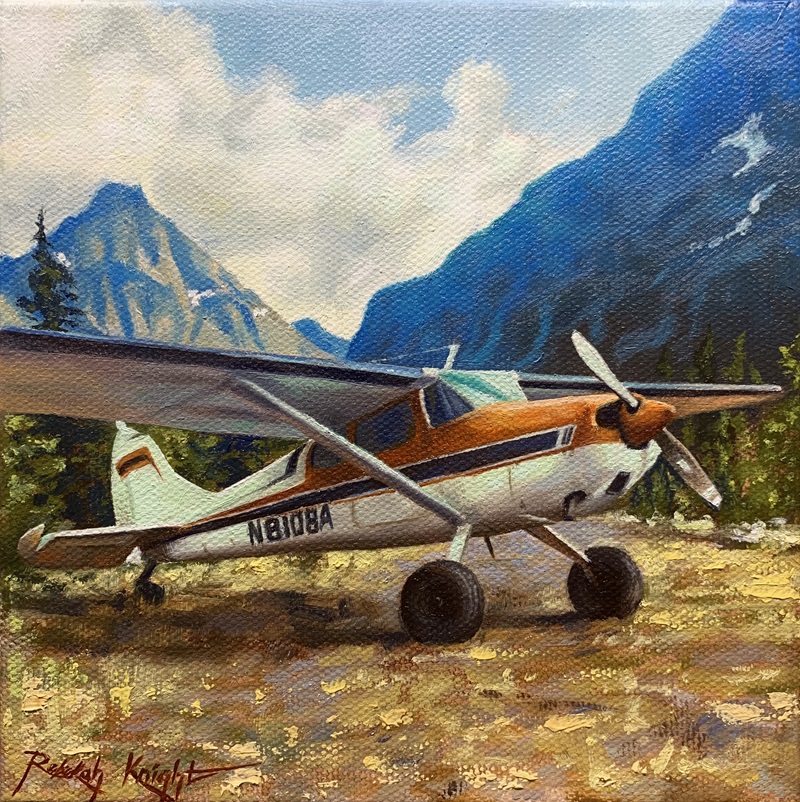
In August 2021, my husband Olen and I went on a river float caribou hunt in the Arctic National Wildlife Refuge on the north slope of the Brooks Range with a group that included Steve Berendzen, manager of the Arctic NWR, and Barry Whitehill, Backcountry Hunters and Anglers board member and former deputy manager of the Yukon Flats NWR, who was kind enough to take us along in trade for a painting. Just weeks after returning home, I went back to Alaska with my artist friend Shalese Sands to photograph moose for art reference, and also found some time to get a bit of mountain flying experience. About a month later, I returned yet again, this time to a place I had never been, and many have never heard of—Adak.
I have never been so viscerally stunned as I was when we emerged from the cloud ceiling that veiled the landscape for the past three hours since departure in Anchorage, which was now a thousand miles behind us to the northeast. It was around 4 PM and deep into the golden hour. The island seemed like something out of a graphically impressive video game, with gradients of gold grass against a slate-blue sky, which had me trying hard to figure out how I would ever be able to convey this feeling through a painting. Taking pictures through the thick Boeing 737 window with my cell phone felt pointless. As I watched the terrain quickly rise up the window, we finally touched down on Adak Island, Alaska.
The island is one among the Aleutian chain that extends out from Alaska to the southwest, and is closer to Russia than mainland Alaska. It is the most westerly point in the United States that one can visit without requiring military authorization. What makes Adak Island so mysterious and unique is its deserted military base that was once the Adak Naval Air Station, which was in operation until the late 90’s when it was defunded and later turned over to the Aleut Corporation. Over two decades of salty air and extreme winds has left every building appearing as though it was abandoned two centuries ago, and evokes an eerie feeling that makes it hard to believe you’re still in the United States.
Most of the island is very mountainous—much more mountainous than I had anticipated when viewing it from satellite imagery. Pothole-riddled roads extend throughout a small portion of the Island that connect various military facilities, but the majority of Adak, which is comprised of the Alaska Maritime NWR, is only accessible by foot or by boat. Only about fifty people reside on the island permanently, and the rest of the residents are mostly birds—a variety of waterfowl, ptarmigan, ravens, and eagles that are as abundant as our backyard birds in the Lower 48. Besides invasive rodents (such as rats), there is only one mammal that seems unlikely for an island that is so far and isolated from the mainland. They were introduced in the 1950’s as a backup food source for residents of the military base. With no predators and mild winter temperatures, they have thrived in abundance ever since. That species is the caribou, and it was one of the reasons for my visit. This was a hunting trip, or rather, a visit to Adak Island with a caribou tag in my pocket, which had not been filled on my arctic hunt months prior. Caribou season on Adak is open year-round in order to help manage an otherwise overly-increasing population. According to the U.S. Fish and Wildlife Service, the Aleutian Islands “did not evolve with large herbivores, and domestic grazers can change the vegetation structure and composition and cause significant erosion. […] As an island reaches carrying capacity for an invasive grazer, annual herd size typically fluctuates with a declining trend because of increasing damage to vegetation and soils.”
While the quest to fill my caribou tag was only part of it, the primary reason I ended up coming to Adak was a bit serendipitous, as most of my favorite adventures have been. One of the hunting outfitters on the island, called Aleutian Outfitters, offered me a 7-day stay in one of their lodges in exchange for my Federal duck stamp entry from that year, which featured a king eider standing on St. Paul Island, Alaska, with a TDB waterfowling boat in the background to fulfill the requirement to include a hunting element (the mandate has since been removed). As it turns out, only one person on St. Paul Island has a boat like the one I painted, and it happens to be one of the guides for Aleutian Outfitters. Without hesitation I accepted the offer, strapped my painting to my luggage and booked a ticket back to Alaska. As reluctant as I was to include a boat in my duck stamp entry last year, it created a chain of events that landed me this great opportunity.
The very evening I arrived on Adak, I got my first duck—an Aleutian/common teal hen, which is a sub-species of Eurasian teal and is similar in appearance to a green-winged teal, but larger in size. Not a single day thereafter did I return to the lodge empty-handed, in spite of heavy wind, rain and snow. After all, Adak Island is aptly nicknamed “Birthplace of the Wind.” I experienced the various challenges that come with waterfowl, upland game bird and big game hunting. It wasn’t until the very last day that I filled my caribou tag since we were able to take the boat out and explore more of the island. This would be almost impossible to traverse afoot round-trip in one day, at least for a flatlander from Missouri such as myself.

My camera was always at my side, and I shot my fair share of eagles, ravens, swans and emperor geese with the shutter. The variety of birds was indeed abundant, but not as abundant as they are during the spring migration, when many Asiatic species grace the mudflats, beaches and puddles of this permanently wet island. Some of the common waterfowl species I encountered included harlequin, Eurasian wigeon, black scoter, Pacific eider, bufflehead, Aleutian teal, whooper swan and droves of emperor geese. The abandoned buildings in town provided some really unique and moody photo opportunities, and the constantly changing weather offered a large variety of beautiful light that often lasted only for short moments.
Adak is a little-known treasure of the United States that offers some of the most special waterfowl hunting, photography and birding opportunities in the nation. There is something about this place that has impacted all of my senses that I hope to translate into my art. The deep storm-blues of the sky, the sweeping golden terrain studded with rusted buildings and the feeling of a lonely yet peaceful land reminds me of the work of Andrew Wyeth. Crashing waves against black rocky shores and a sky teeming with birds riding the wind was something I could have sat and watched for hours. I look forward to the art that will come from this experience and to a return trip in the future. If you are an avid birder, hunter, wildlife photographer/artist or an outdoor enthusiast, I would highly recommend adding the Alaska Maritime National Wildlife Refuge and the Aleutian Islands to your bucket list. This remarkable place and others like it are for us to enjoy, learn from and take care of, and what a privilege it is to participate in that responsibility.
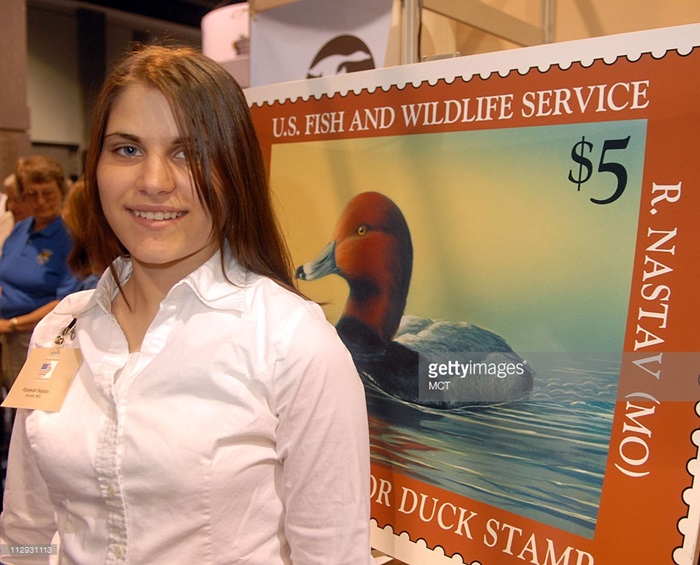
Rebekah Knight is a wildlife artist and avid photographer. Winner of the Federal Junior Duck Stamp Contest in 2006, she's been drawing and painting since childhood. You can see her art by following her on instagram @reb.knight.art or visit her website RebekahKnight.com. Rebekah is a member of the board of the Friends of Migratory Bird/Duck Stamp and lives in Missouri. This article also appears in Wingtips, the newsletter of the Friends. Rebekah has been a talented artist since she was a young girl and she started entering the junior duck stamp contest when she was 13 years old. When she was 15, in 2006, her entry of a Redhead drake (titled "Morning Swim") was selected as the winner (see below).
Photos and artwork displayed in this blog are all courtesy of Rebekah Knight.