Saving the Sagebrush Biome
Scientists say it's time to flip the script to conserve what's left of the shrinking sagebrush biome
- By Brianna Randall
- Conservation
- Sep 24, 2025
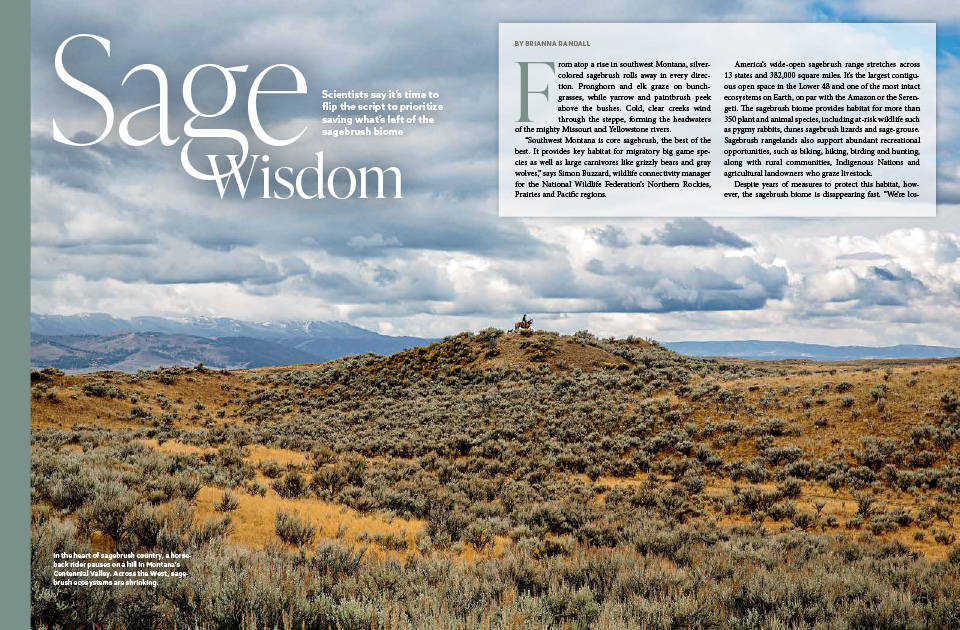
In the heart of sagebrush country, a horseback rider pauses on a hill in Montana’s Centennial Valley. Across the West, sagebrush ecosystems are shrinking. (Photo by Louise Johns)
FROM ATOP A RISE IN SOUTHWEST MONTANA, silver-colored sagebrush rolls away in every direction. Pronghorn and elk graze on bunchgrasses, while yarrow and paintbrush peek above the bushes. Cold, clear creeks wind through the steppe, forming the headwaters of the mighty Missouri and Yellowstone rivers.
“Southwest Montana is core sagebrush, the best of the best. It provides key habitat for migratory big game species as well as large carnivores like grizzly bears and gray wolves,” says Simon Buzzard, wildlife connectivity manager for the National Wildlife Federation’s Northern Rockies, Prairies and Pacific regions.
America’s wide-open sagebrush range stretches across 13 states and 382,000 square miles. It’s the largest contiguous open space in the Lower 48 and one of the most intact ecosystems on Earth, on par with the Amazon or the Serengeti. The sagebrush biome provides habitat for more than 350 plant and animal species, including at-risk wildlife such as pygmy rabbits, dunes sagebrush lizards and sage-grouse. Sagebrush rangelands also support abundant recreational opportunities, such as biking, hiking, birding and hunting, along with rural communities, Indigenous Nations and agricultural landowners who graze livestock.
Despite years of measures to protect this habitat, however, the sagebrush biome is disappearing fast. “We’re losing 760,000 acres of core sagebrush each year,” says Tina Mozelewski, technical program manager at the nonprofit Spatial Informatics Group–Natural Assets Laboratory. “It’s a wake-up call that we need to change what we’re doing.” In 2024, Mozelewski and 70 other experts sounded that call, publishing a suite of sagebrush-related research in a special issue of Rangeland Ecology & Management (REM). Their research shows that to conserve what’s left of the sagebrush ecosystem, “business as usual is not going to cut it,” she says.
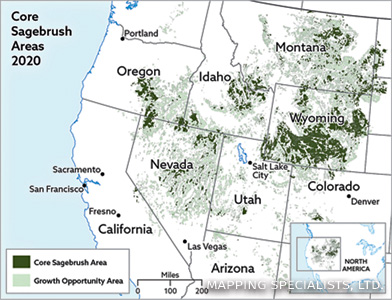
Two years earlier, local, state and federal partners had developed a framework, Sagebrush Conservation Design, to better target resources invested in the biome’s conservation. Based on satellite imagery that tracks vegetation over the past seven decades, the design delineated core and degraded sagebrush zones. Core areas have the highest amount of native shrubs and perennial plants and the least amount of invasive weeds or encroaching trees. “These are the places that have changed the least over time,” says Joe Smith, a rangeland ecologist at the University of Montana and a member of the Natural Resources Conservation Service’s Working Lands for Wildlife team that helped develop the framework.
Yet Mozelewski’s research reveals that between 2000 and 2020, only about 20 percent of all sagebrush conservation funding went to protecting these intact core areas, while 80 percent was spent on restoring degraded areas. She says that if we flipped the funding script—funneling 80 percent into protecting core areas—we’d be five times more effective at conserving the sagebrush biome. Nicknamed “defend the core,” this new approach is starting to catch on around the West.
Defending the core does not mean writing off degraded areas, Mozelewski notes, but changing why and how to invest in those places—building wildfire fuel breaks to protect communities or prioritizing key wildlife migration corridors, for example.
Buzzard agrees. “To conserve remaining big game migrations, we’re going to have to put some effort into degraded areas,” he says. But overall, he favors the focus on core habitat. “The primary reason that initial attempts to conserve and rebound declining sage-grouse were ineffective is because they were too species specific and did not take into account the full scope of habitat health,” he says. “NWF and our partners prioritize working in important, intact landscapes.”
Like Buzzard, others agree with the big-picture strategy but see the need for a nuanced approach at the local level. For more than 20,000 years, Indigenous Peoples from dozens of groups have inhabited the sagebrush biome. “For us, the sagebrush ecosystem is a source of medicine and food that we still utilize ceremonially,” says Jason Baldes, a member of the Eastern Shoshone Tribe in present-day Wyoming and director of NWF’s Tribal Bison Program. Bison, a keystone species of the sagebrush biome, once numbered 30 to 60 million. But due to the dispossession of Indigenous groups and the federal-government-sponsored slaughter of bison in the 19th century, bison are now considered ecologically extinct. Bringing bison back will require “out-of-the-box, landscape-wide conservation approaches,” Baldes says.
Baldes believes that working across jurisdictional boundaries to defend core habitat “is certainly a more well-aligned approach to conservation, one that translates to restoring both bison and sagebrush ecosystems.” Like Buzzard, he adds a caveat: “I think we need to have a mosaic of conservation priorities ... and some degraded areas may be important to bison that are not part of a larger core system.”

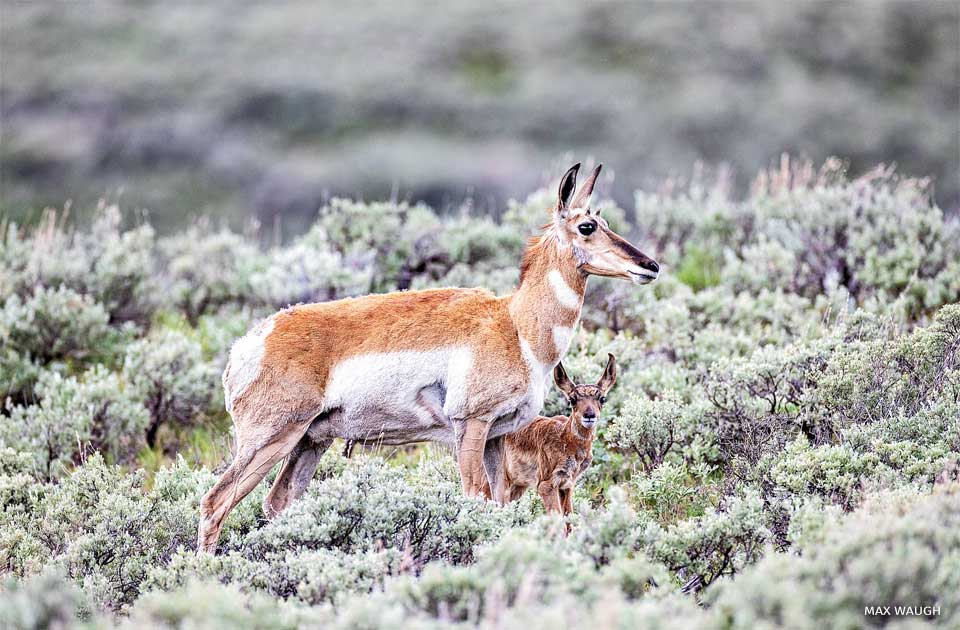
During migration, wildlife such as pronghorn (above) may traverse degraded sagebrush areas but do best in core habitats. Although America’s sagebrush biome is vast (below, map source: Doherty K. et al., 2022, U.S. Geological Survey Data Release), little of what remains qualifies as core sagebrush: areas with the highest quantity of native shrubs and perennial plants and the least amount of invasive weeds or encroaching trees.
Sagebrush invaders
Scientists say that nearly 90 percent of core sagebrush loss stems from two threats: invasive annual grasses, including cheatgrass, ventenata and medusahead; and encroaching native conifers such as pinyon pine and western juniper that are expanding their ranges as a result of fire suppression. Both kinds of intruding vegetation end up replacing native perennial plants, impacting water and nutrient cycling and degrading habitat for sagebrush wildlife.
Invasive annual grasses are especially worrisome because they gobble up sagebrush habitat quickly. They also fuel more frequent fires across the rangelands where sagebrush grows. Cheatgrass—a species native to Eurasia that was introduced in the 1800s—spreads quickly via seed. It dries out much faster than native plants, sending sagebrush habitat up in flames every few years instead of every several decades, which was the historic fire cycle in sagebrush country.
As more conifers infiltrate the range, those fires rage hotter, leaving more bare ground for invasive grasses to colonize postfire. This vicious cycle can “transform and degrade habitat to the point where it’s hard to get it back,” says Buzzard, with dire consequences both for wildlife and rural communities. (Read more about fires.) According to research conducted by Michele Crist, wildland fire science program coordinator for the U.S. Geological Survey (USGS), some 2.1 million acres of sagebrush rangelands burn in an average year.
The good news is that native perennial plants and shrubs are more resistant to wildfires: Less than 2 percent of Crist’s estimated annual fires occur in core sagebrush areas. Because core areas tend to be farther from human development, they are less prone to human-caused ignitions, which account for 90 percent of all fire starts.
Invasive grasses are an extremely challenging threat to tackle, in part because they are fast-moving and widespread. Using a free remote-sensing app called the Rangeland Analysis Platform, Smith has documented an eightfold increase in cheatgrass since 1990 across the Great Basin, a wide swath of land that includes portions of Oregon, Nevada, Idaho, Utah and California. “You can see the cover of invasive grasses double from one year to the next, and there’s no silver bullet to combat them yet,” he says. “We could see the iconic sagebrush ecosystem transformed into a highly flammable landscape within one lifetime.”
Fortunately, new mapping technology like the Rangeland Analysis Platform is helping pinpoint where to target cheatgrass treatments. Once scientists determine the extent of the problem—a single pasture or an entire watershed—the next step is to inventory how bad it is. Are any native plants left? If not, will bare ground need to be replanted once the invasives are gone? Land managers then can decide if and where to spray an herbicide. New preemergent herbicides such as Rejuvra are showing promise for halting cheatgrass in its tracks. Like other herbicides, these chemicals could inadvertently harm native plants or animals or accumulate in waterways. Yet because they kill seeds of invasive grasses in the soil’s upper layers, they allow deep-rooted native perennials to come back in spring.
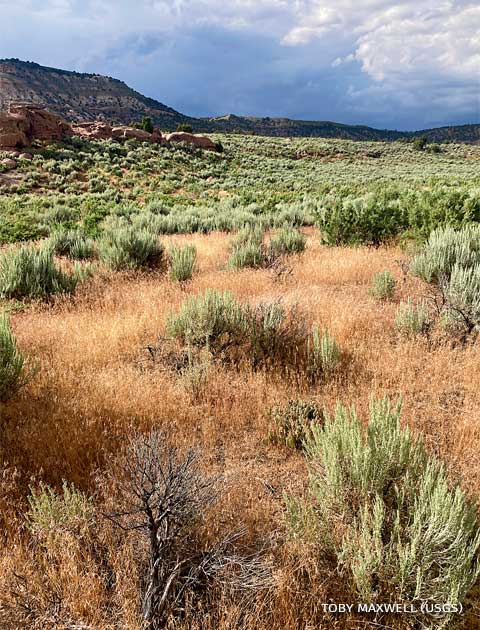
South of Rock Springs, Wyoming, cheatgrass has invaded the spaces surrounding sagebrush, displacing native perennials and degrading the habitat.
Recipes for success
In Wyoming, Sublette County provides hope for winning the battle against cheatgrass. Using preemergent herbicides on more than 97,000 acres since 2015, a team of public and private partners has treated nearly every known cheatgrass infestation in the county. So far, the invasives have not come back. The county’s success is inspiring more people to defend their own sagebrush rangelands. Over the past two years, the University of Wyoming’s Institute for Managing Annual Grasses Invading Natural Ecosystems (IMAGINE) has hosted virtual and in-person workshops across the West, teaching 850 people how to use mapping tools, herbicides, targeted livestock grazing and other strategies to keep invasives at bay. Claire Visconti, an IMAGINE outreach coordinator and assistant research scientist, says the workshops “take people from ‘defending the core’ to ‘defending your core.’”
Defending sagebrush cores also means keeping them tree-free. The approach to eliminate encroaching conifers can be more clear-cut than eradicating cheatgrass: Just lop them down as they spread into sagebrush habitat, preferably as small saplings before they mature and produce thousands of seeds. The trick is to manage for tree-free sagebrush landscapes at large scales.
An impressive example is in southern Idaho, where public land managers and private landowners have been removing encroaching junipers from more than 400 square miles of sagebrush habitats since 2004. Smith and his colleagues studied 288 treated sites and found that perennial plants and shrubs recovered following tree removal.
Such projects have boosted populations of sagebrush-loving birds. “It’s pretty clear that sagebrush birds are more abundant and have better reproductive success in areas with less trees,” says Elise Zarri, an ecologist with the University of Montana’s Working Lands for Wildlife research team.
From 2019 to 2022, Zarri tracked the nesting success of eight songbird species in a valley in southwest Montana, a region where tree cover has doubled since 1990. She surveyed sites where the Bureau of Land Management had removed Douglas fir trees to restore sagebrush habitat as well as other sites where no trees had been cut.
Fledgling production for the Brewer’s sparrow—a 5-inch-long bird known for its extended, buzzy songs and a species of conservation concern in several western states—was 119 percent higher in the locations without trees. The birds avoided nesting within 98 feet of a tree, Zarri says. “They were cramming their territories into tree-free areas. It made me wonder how much habitat we’ve lost for Brewer’s sparrows and what might happen in the future if trees continue to fill in.”
To find out, she overlaid the territories of 1,161 Brewer’s sparrows with historical aerial imagery and ran simulations to model past and future abundance of the birds in the valley. This part of Montana already has lost one-quarter of its Brewer’s sparrow population during the past 70 years, and Zarri’s simulations show that their numbers will decline an additional 60 percent in the next 30 years if no action is taken to remove encroaching trees. If trees are actively managed in the future, she says, an estimated 460 Brewer’s sparrow fledglings will flit around the valley each year, but the number of offspring craters to just 200 fledglings with no tree removal. “If we defend the core, we can stem the loss and hold the line for the animals and people that rely on these habitats,” Zarri says.
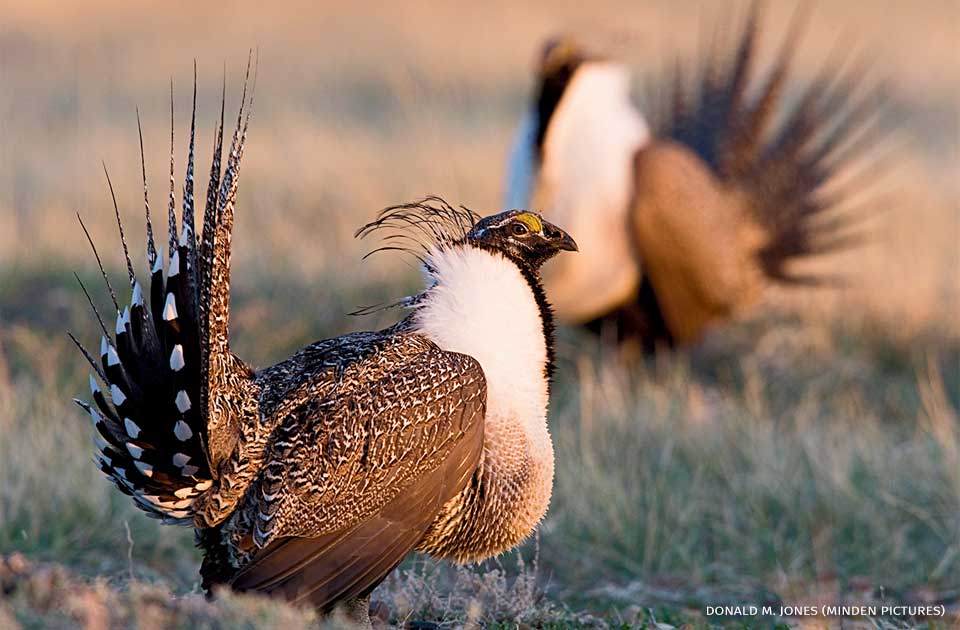
During spring mating season, male greater sage-grouse display in eastern Montana.
Saving signature species
Well known for the male’s elaborate courtship dances at communal display grounds during the mating season, the greater sage-grouse is a signature species of sagebrush ecosystems. Greater sage-grouse also “are a very important cultural and iconic species to many Native American Tribes,” Baldes says. Dependent on sagebrush plants for food, cover and roosting, the plump, chicken-sized birds have declined by 80 percent since 1965, largely due to habitat loss, fragmentation and degradation. “We need to consider how development and encroachment are impacting that bird and its habitat and overall biodiversity,” Baldes says.
Because trees can shelter predators, sage-grouse, like Brewer’s sparrows, avoid nesting in landscapes with more than a few trees per acre. In southern Oregon, where partners removed junipers from 54 square miles of public and private lands, the birds’ numbers were 12 percent higher than in neighboring landscapes where trees remained, a 2021 study published in Ecosphere found. “These birds evolved with cover that’s fairly flat and low to the ground, so they aren’t accustomed to tall structures and defending against the predators that come with them, like raptors, weasels or chipmunks,” Zarri says.
According to two studies published in the REM special issue, protecting core sagebrush is synonymous with saving sage-grouse. One study found that while populations of sage-grouse remained stable in core areas biome-wide between 1996 and 2021, they dropped by a staggering 64 percent in degraded rangelands. And on the California–Nevada border, a distinct population of sage-grouse has increased by an estimated 37.4 percent since 2012 in areas where targeted conservation efforts kept core sagebrush intact compared to places where no conservation took place. “By protecting these core areas we’re protecting essentially all life stages of sage-grouse,” says Peter Coates, a USGS wildlife biologist and a co-author of both studies.
The best way to maintain these core areas and the wildlife that thrive in them is by working across ownership boundaries and at large scales, as evidenced by success stories in Wyoming, Idaho and Montana, Buzzard says. “The recipe for success is collaborative, on-the-ground conservation programs and local partnerships,” he adds. This ensures that private landowners and agencies “are all speaking the same language in terms of priorities on the landscape and how to tackle them.”
NWF priority
Habitat Connectivity
Across the sagebrush range, migratory big-game animals, such as pronghorn and elk, must traverse a maze of potentially harmful fences during their seasonal movements. In southwest Montana, the National Wildlife Federation has helped landowners remove or modify 72 miles of dangerous fencing since 2021. Learn more.
Brianna Randall is a science and travel writer based in Missoula, Montana.
More from National Wildlife magazine and the National Wildlife Federation:
Keeping the Greater Sage-Grouse off the Endangered Species List »
Behind the Scenes of ‘A Buffalo Story’ »
Blog: Collaboration is Key to Conserving the Sagebrush Ecosystem »